Yes, but the phasing order has to follow sensor technology and power source, not just which lav lines are easiest to isolate. Mixing infrared and capacitive fixtures in the same restroom during a rolling retrofit produces inconsistent activation behavior between fixtures that otherwise look identical, and users read that inconsistency as a broken faucet rather than a transition in progress. The fix is to group the retrofit by detection method and power source first, then let plumbing convenience set the order within each group.
Why mixed sensor types confuse users
Infrared sensor faucets typically detect at 4 to 6 inches from the spout, using a reflected beam off hands or dishware. Capacitive sensors work on a field-based principle, sensing the change in capacitance as a body approaches the trigger zone, and the effective range depends on sensitivity tuning rather than a fixed beam geometry. Both work. The problem is what happens when a user moves between a bank of IR faucets and a bank of capacitive ones in the same room.
A user trained on IR habitually hovers hands close, 2 to 3 inches, because that is what worked at the last sink. A capacitive unit tuned for a wider field may trigger early, before hands are positioned under the spout, producing a short burst of water that looks like a glitch. Reverse the scenario and an IR unit that needs a closer presence will seem unresponsive to someone used to capacitive range. Neither faucet is malfunctioning. The detection logic is just different, and in a single restroom with say six lavs, users do not distinguish between generations of hardware. They distinguish between “this one works” and “this one doesn’t.”
Grouping fixtures by detection technology
Before scheduling any replacement, inventory what’s currently installed by sensor type, not just by brand or faucet model. Two faucets from the same manufacturer can use different detection technology across product lines, so check the spec sheet or the sensor module part number rather than assuming consistency.
- IR units: confirm range specification (commonly 4 to 6 inches) and beam angle, since narrow-angle IR behaves differently from wide-angle IR even within the same category.
- Capacitive units: confirm sensitivity adjustment range and whether the field is factory-set or field-tunable, since tunable capacitive sensors can be matched closer to an existing IR bank’s apparent behavior during transition.
- Hybrid or dual-technology units: some newer fixtures combine both methods for range and false-trigger rejection. Treat these as their own category rather than lumping them with either pure IR or pure capacitive stock.
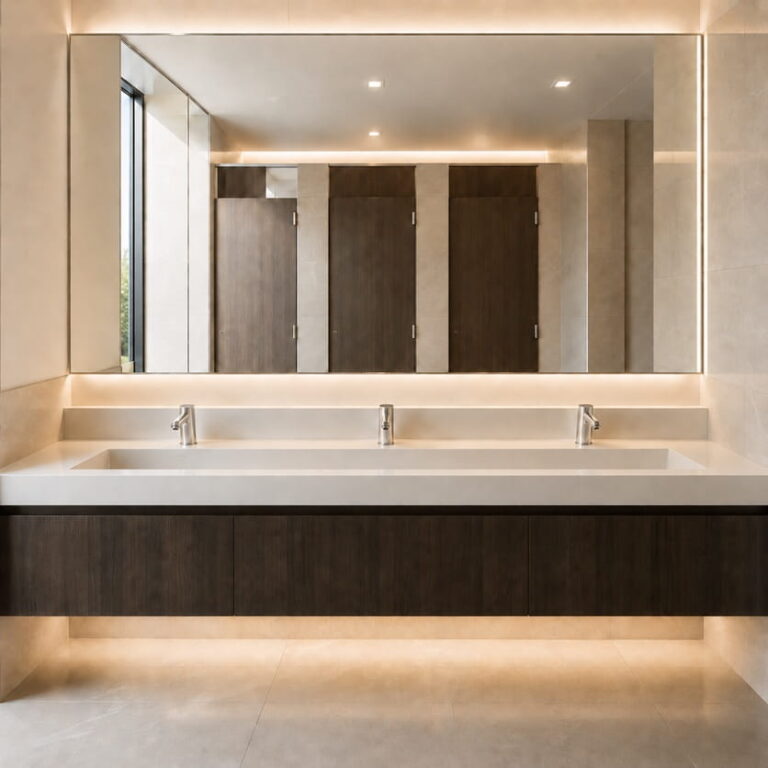
Once you know the inventory, replace one full bank or one full wall of fixtures per phase, not individual faucets scattered through the room. A user standing at a six-faucet trough should experience uniform behavior across every tap in that run, even if the restroom overall is mid-retrofit.
Power source conflicts during transition
Detection technology is half the compatibility question. Power source is the other half, and it’s the one that gets overlooked because it doesn’t show up as a visible user complaint until something fails.
Battery-powered units, typically running on lithium AA packs, are rated for roughly 150,000 to 200,000 cycles before the battery degrades to the point of unreliable actuation. Hardwired units draw from building power and don’t have a cycle-dependent power ceiling, but they require a dedicated low-voltage run back to a transformer, which is a rough-in constraint, not a sensor constraint. Hydro-powered units generate their own power from water flow through an internal turbine, and they need a minimum flow rate, commonly cited around 0.5 GPM, to keep the turbine charged. Drop below that minimum on a low-flow or partially restricted line and the unit’s battery backup drains faster than it recharges, leading to intermittent operation that looks identical to a dying standard battery.
During a phased retrofit, this matters because the plumbing you’re already disturbing for one faucet type may not suit another. If you’re pulling battery-powered units and specifying hydro-powered replacements, verify actual static and flow pressure at that specific lav, not just the building’s nominal supply pressure, before committing the whole phase to hydro power. A fixture that tests fine on the first install in a phase can still underperform two fixtures down the branch line if pressure drops across the run.
Staging solenoid wear across phases
The solenoid valve is the component most likely to fail first in a sensor faucet, independent of the sensor type sitting in front of it. Rated cycle life is commonly around 500,000 actuations before seat wear causes dripping or failure to fully close. In a high-traffic commercial restroom, that cycle count is reached faster than most maintenance leads expect, often within a few years depending on traffic volume and water quality (mineral content accelerates seat wear).
When phasing a retrofit, note the install date and, if available, the actuation count or estimated traffic load for each fixture you’re not yet replacing. The goal is to avoid a scenario where phase one fixtures (newly installed) are still under warranty and working perfectly while phase three fixtures (original equipment, untouched) start failing solenoids mid-project. That’s not a sensor compatibility problem, but it does affect your phasing order: prioritize replacing fixtures with the highest estimated cycle count first, provided doing so doesn’t break the sensor-technology grouping you’ve already established.
If your existing fixtures don’t have cycle counters, use install date and estimated daily traffic as a proxy. A faucet in a stadium concourse restroom used during events will rack up cycles differently than one in a low-traffic office floor, even if both were installed the same year.
Sequencing by rough-in compatibility
Once fixtures are grouped by sensor technology and power source, the remaining sequencing question is purely plumbing: which rough-ins can accept the new fixture without modification, and which need supply line, drain, or electrical changes.
| Factor | Check before phase |
|---|---|
| Supply connection | Confirm 1/2 inch NPT compatibility or need for adapter |
| Power | Battery compartment clearance, hydro turbine flow minimum, or hardwire transformer location |
| Sensor housing | Deck-mount vs wall-mount sensor eye placement, matches existing counter cutout |
| Mounting hole pattern | Single-hole vs widespread, matches existing countertop or requires escutcheon |
Sequence phases so that fixtures requiring the least rough-in disruption go first within each sensor-technology group. This lets you validate detection behavior and user response on the easy installs before tackling the ones that need supply or electrical rework, so if something about the sensor tuning needs adjustment, you catch it early rather than after the whole bank is committed. When specifying replacement stock, look at manufacturer lines built around consistent sensor platforms across models, since that consistency is what let you source commercial touchless faucets for a phased job without introducing a third detection technology into a restroom that’s already running two.
What to check before you start
Pull the spec sheet or sensor module number for every existing fixture in the restroom, not just the ones scheduled for phase one. Confirm detection technology and range, rated solenoid cycle life if published, and power source including minimum flow for hydro units. Group the retrofit plan by sensor technology first, power source second, and rough-in convenience third. If you inherit a restroom with undocumented mixed-generation fixtures and no clear sensor inventory, that’s the point to bring in a plumbing engineer or the fixture manufacturer’s technical rep before locking a phasing schedule, since guessing at sensor compatibility is what produces the inconsistent user experience this approach is meant to avoid.