
Deep technical FAQ for AEC teams and facility operators
FAQ
Technical answers for teams specifying and supporting sensor faucets in commercial restrooms. Built for AEC workflows, submittals, and maintenance plans.
This FAQ is written for readers who already work with fixture schedules, submittals, rough-ins, and O&M closeout packages.
The focus here is what actually causes field failures: sensor behavior under real lighting, basin interaction and splash,
flow and pressure variability, mixing strategy, power planning, and repeatable commissioning checks.
Open the evidence library
Jump to performance FAQ
Commissioning deliverables
How to use this page: filter by tags, then search keywords like “false trigger,” “dynamic pressure,” “tempered loop,” “Legionella,” “laminar,” or “solenoid.”
Each answer includes at least one supporting source link.
Evidence library
Primary sources, standards, and research papers used to support the FAQ answers. Use these links for specs, design narratives, and closeout notes.
EPA WaterSense performance basis for lavatory faucets
WaterSense documentation on how performance requirements and acceptable flow rates were developed for faucets and accessories.
Agency guidance
Open EPA PDF
EPA WaterSense at Work: commercial faucet flow guidance
Commercial guidance on flow rates, metering, and retrofit approaches for public restroom faucets.
Agency guidance
Open EPA PDF
CSA Group research: faucet flow rate vs handwashing efficacy
Independent research examining how faucet flow rate can impact handwashing outcomes using a public health protocol.
Independent study
Open CSA PDF
Building & Environment paper: flow rate and basin bioaerosols
Peer-reviewed study on how flow rate and basin dynamics affect droplet and aerosol dispersion and potential splashback pathways.
Peer-reviewed
Open paper
Flinders University coverage of basin “splashback” findings
University-led summary referencing the Building & Environment paper and implications for healthcare and aged care hand basins.
University-led
Open summary PDF
Healthcare infection control: electronic faucets and waterborne risk
Johns Hopkins reporting on research that found higher contamination in certain hands-free faucet conditions and the operational context around it.
University / healthcare
Open JHU article
Peer-reviewed: electronic-eye faucets and Legionella contamination
Journal abstract and publication record related to Legionella recovery and electronic faucet component contamination in healthcare settings.
Peer-reviewed
Open Cambridge
Open UT Southwestern record
APIC & ASHE statement: electronic faucets in healthcare
Industry guidance discussing findings, contributing factors, and practical strategies to reduce risk in healthcare environments.
Industry guidance
Open APIC/ASHE PDF
CDC water management program toolkit (Legionella)
CDC toolkit and PDF guide for developing water management programs to reduce Legionella growth and spread in buildings.
Agency guidance
Open CDC toolkit
Open CDC PDF
ASHRAE 188: Legionellosis risk management for building water systems
ASHRAE standard establishing minimum requirements for legionellosis risk management in building water systems.
Standard
Open ASHRAE page
ADA / Access Board guides for lavatories and operable parts
Design guidance on lavatory requirements and operable parts criteria applicable to faucet controls and related accessories.
Accessibility guidance
Lavatories guide
Operable parts guide
2010 ADA Standards
Field context image frames
Use these slots for your project photos, test setups, and commissioning documentation images.
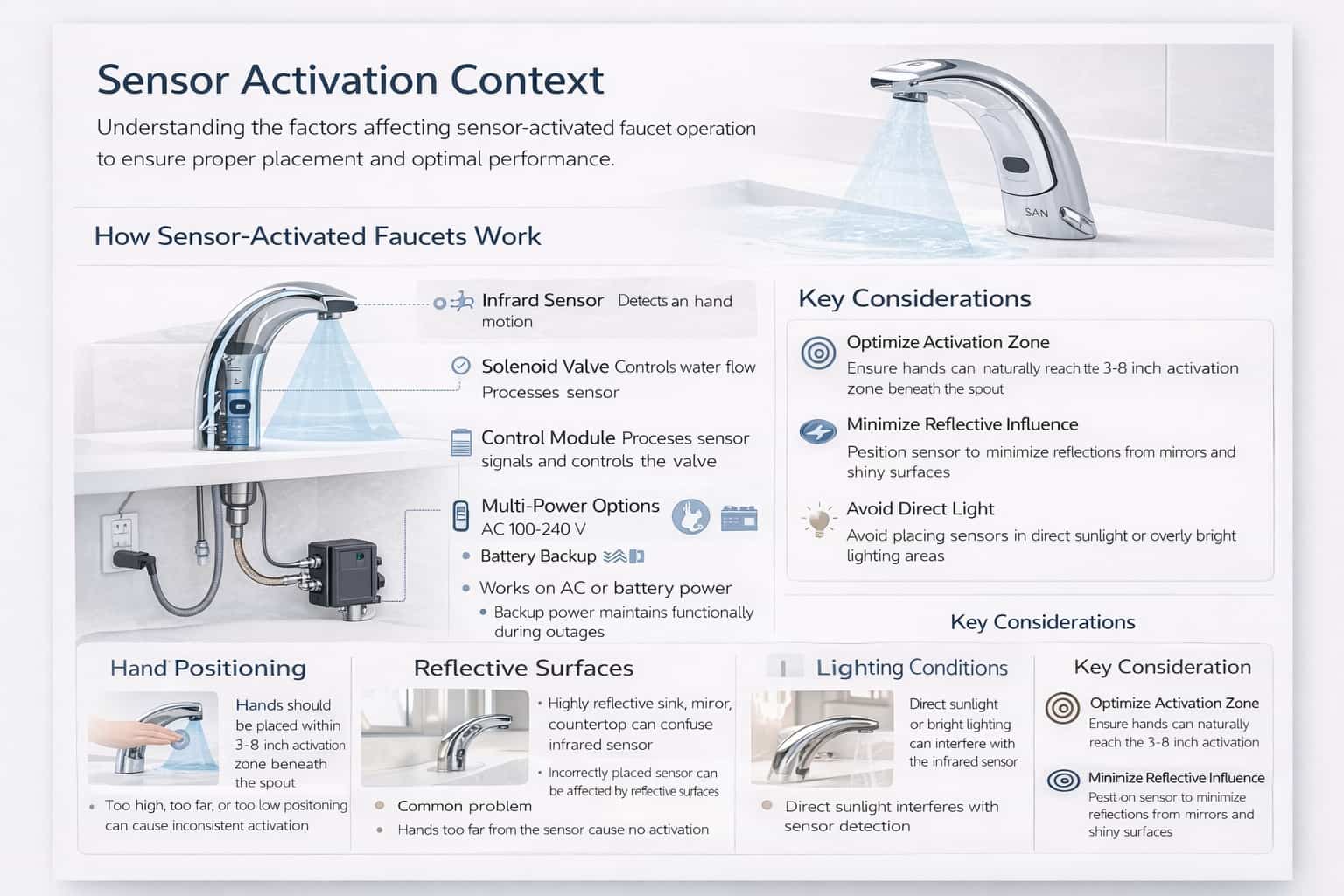
Sensor activation context
Capture detection zone, user approach angles, and misfire conditions
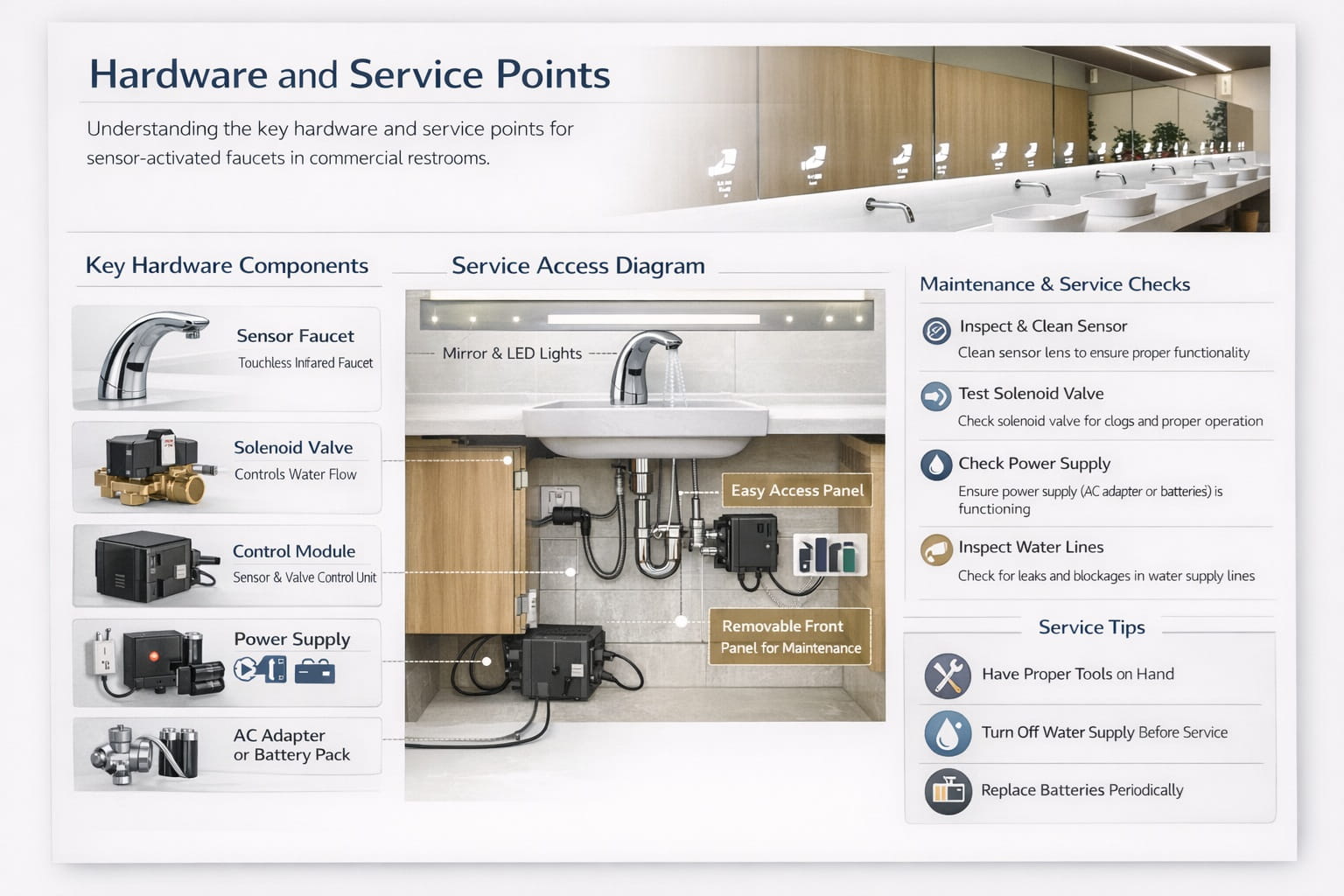
Hardware and service points
Photograph solenoid access, stops, strainers, and mounting points
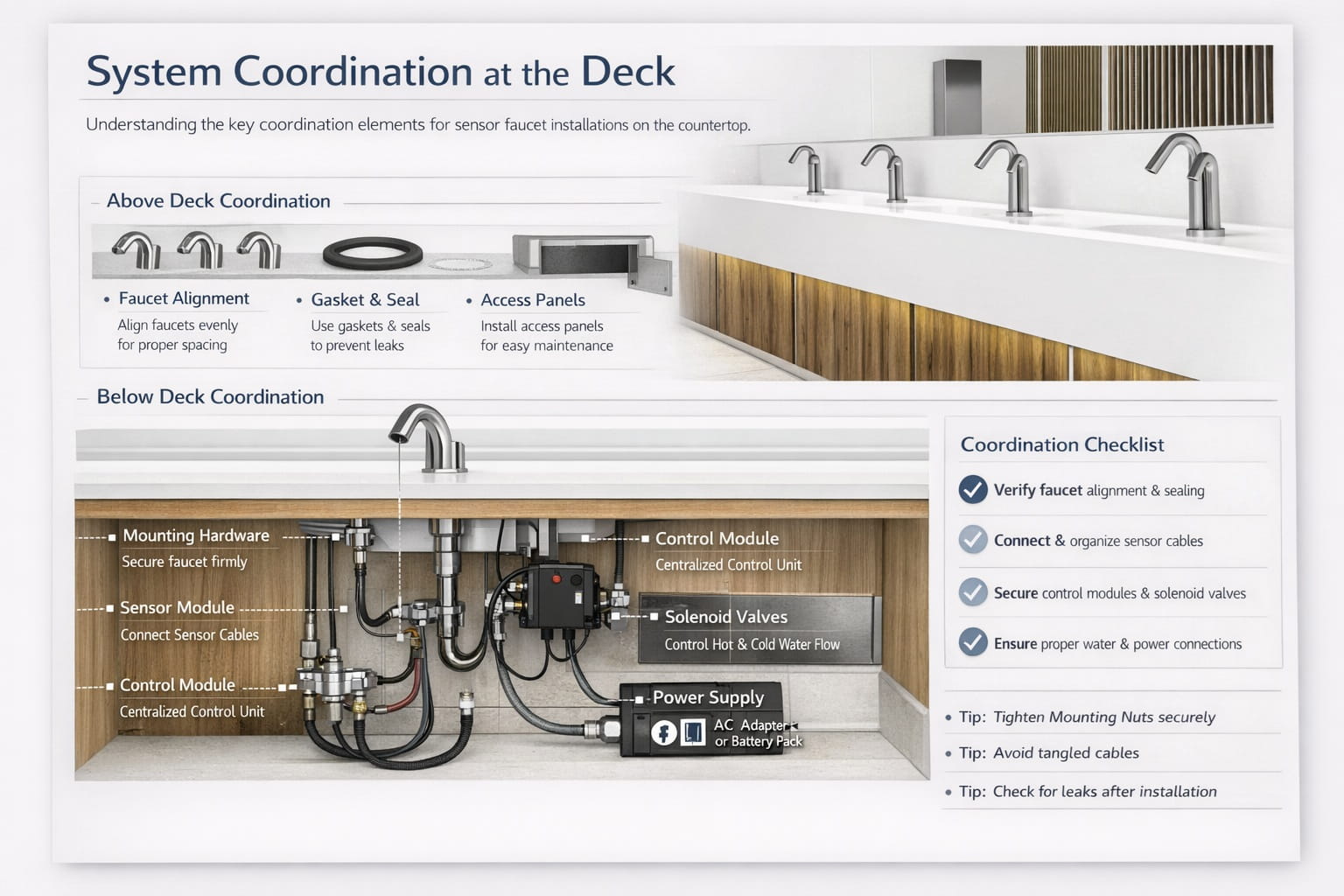
System coordination at the deck
Document reach, spacing, and cross-activation risk between fixtures
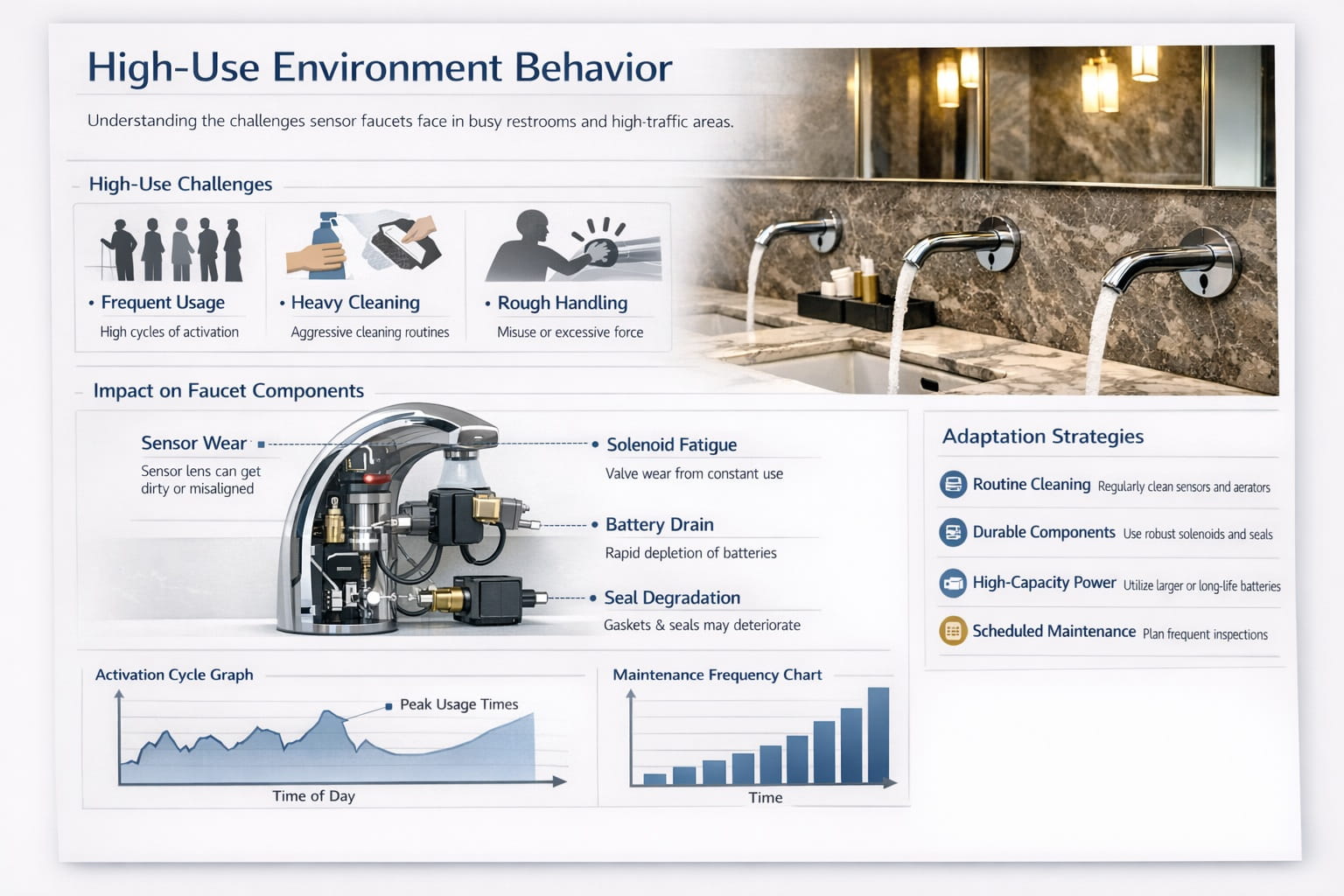
High-use environment behavior
Track throughput, splash behavior, and user flow under peak demand
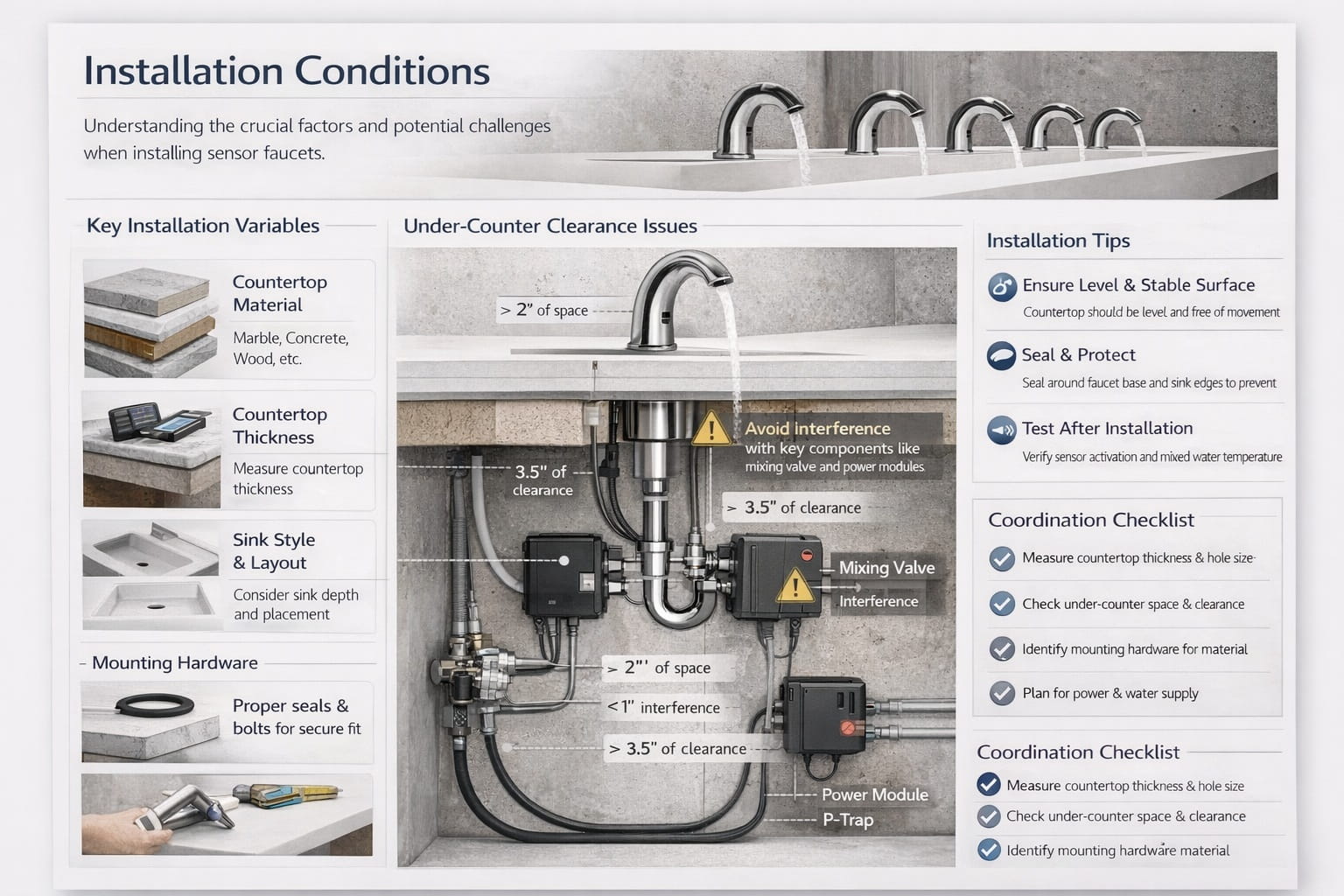
Installation conditions
Clearances, backsplash constraints, and under-counter routing
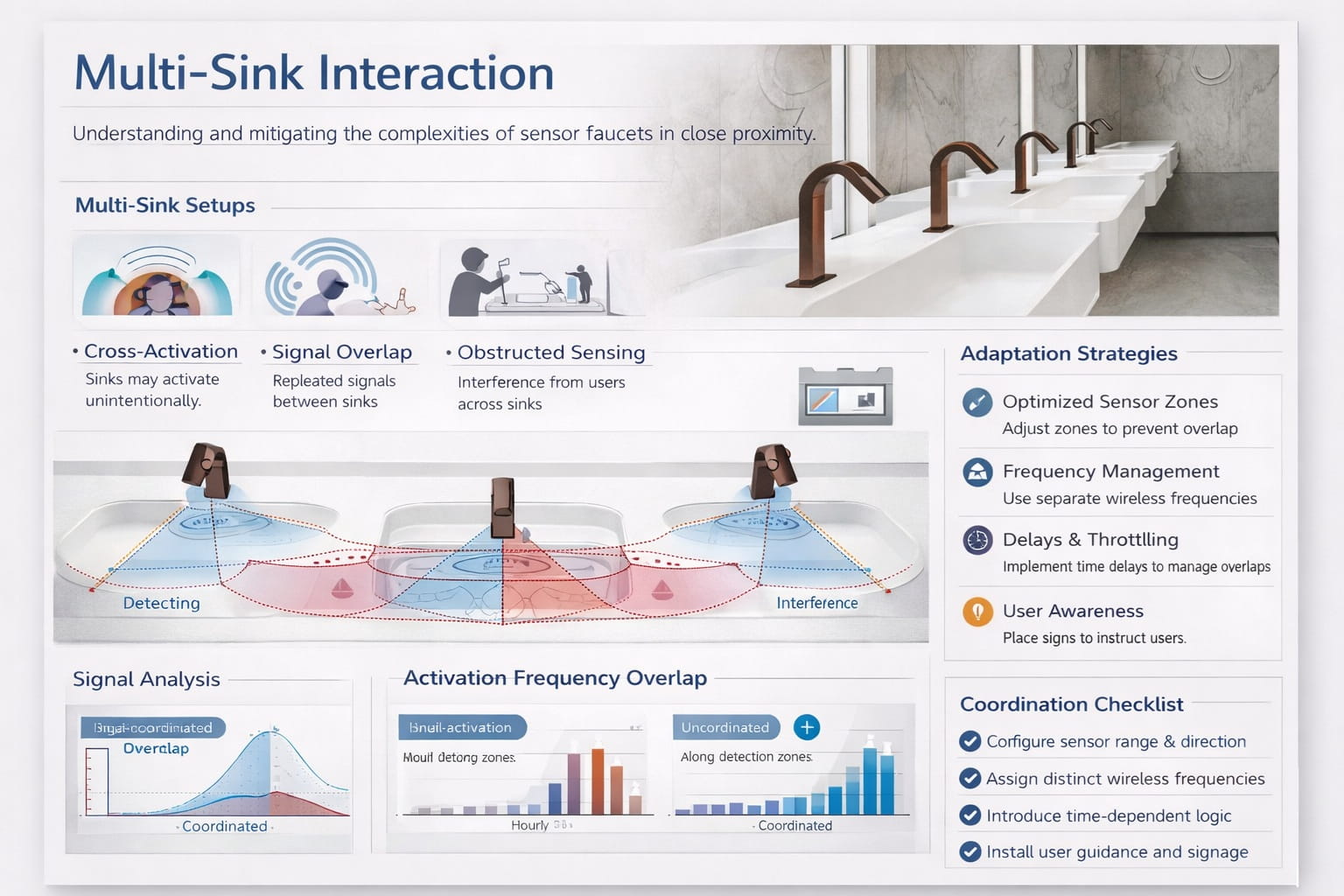
Multi-sink interaction
Commissioning checks for adjacent activation and mirrored surfaces
Filter and search
Search
Sensor performance and false triggers
Root causes of unstable activation, short cycling, and shutoff problems under real lighting and basin conditions.
How do reflective surfaces and lighting create false triggers or non-activation in IR sensors?
performancebasinrisk
⌄
Many IR faucets infer “hands present” from reflected IR energy. Mirror finishes, glossy basins, chrome trim rings,
and high-contrast lighting can shift return signal behavior enough to cross the detection threshold.
Mitigation approach: define activation stability during commissioning (repeatability under installed lighting),
then tune range or shielding, and verify at multiple times of day.
Supporting reference
IR pulse discrimination
Lavatory context
What should “activation delay” mean in a spec, and how do you measure it in commissioning?
performancecommissioningspec
⌄
“Activation delay” must be test-defined: start condition (hands entering zone), stop condition (first continuous flow),
and repetition (multiple trials per sink position). Report median and worst-case results, not just averages.
Measurement alignment
CSA testing context
Why does the same sensor faucet behave differently across basin types, even when installed correctly?
performancebasinplumbing
⌄
Basin geometry and mounting height determine impact point, splash return, and how droplets travel toward the sensor window.
Shallow bowls and tight drain zones can create upward splash that intermittently blocks or confuses detection.
What to document: spout height above rim, reach vs drain centerline, spray type (laminar vs aerated), and splash travel.
Splash / aerosol evidence
Building & Environment paper
University summary PDF
Hydraulics, pressure variation, and outlets
How to prevent “it worked in the shop” failures caused by dynamic pressure loss, outlet choice, and debris loading.
Static vs dynamic pressure: why do sensor faucets feel inconsistent during peak occupancy?
plumbingperformancespec
⌄
Static pressure can look acceptable on a gauge, while dynamic pressure can collapse under real demand because of undersized piping,
long runs, partially closed stops, strainer loading, or high simultaneous use. Commission under realistic load when possible.
Flow expectations
EPA performance basis
EPA commercial guidance
Laminar vs aerated: how do you decide outlet type for healthcare and high-traffic basins?
plumbingbasinrisk
⌄
Outlet choice changes splash and aerosol behavior, perceived “softness,” and clogging modes.
Treat the decision as a system choice tied to basin depth, impact point, and infection-control intent.
Why do “low flow” complaints persist even when the specified gpm is correct?
plumbingmaintenancerisk
⌄
Low flow complaints are often combined effects: outlet clogging, upstream debris loading, stop throttling,
hot/cold imbalance at mixing points, and dynamic pressure loss under occupancy peaks.
Field check sequence: aerator/laminar device inspection, stop verification, strainer/solenoid screen check (if present),
then timed-fill flow verification to remove “feel” bias.
Flow & performance context
EPA commercial faucets
CSA research PDF
Mixing strategy, temperature stability, and risk
Tempered loops vs point-of-use mixing and why short touchless cycles can create “cold shock” and inconsistent experience.
Point-of-use mixing vs central tempered distribution: what changes for operations and water safety?
mixingplumbingwatermgmt
⌄
Central tempering can stabilize temperature sink-to-sink but creates loop balancing and a single point of drift.
Point-of-use mixing localizes failures but increases the number of devices that must be accessed, calibrated, and documented.
For large buildings, align temperature strategy with a building water management program where required.
Water safety + guidance
CDC WMP toolkit
ASHRAE 188
Why do some touchless faucets start cold and stabilize later, even when the “setpoint” is correct?
mixingperformancecommissioning
⌄
First-draw temperature is dominated by branch conditions and purge time. Touchless cycles can be short enough that the line never fully stabilizes,
especially when hot water is distant or the tempered loop is not balanced. Include an “overnight stagnation” first-draw check in commissioning.
Commissioning context
CDC toolkit PDF
Power planning, controls, and reliability
Battery strategy, hybrid/hardwire coordination, and how “power issues” often appear as “sensor issues.”
Battery systems: what must be in the O&M plan to prevent recurring downtime?
powermaintenancerisk
⌄
Treat batteries like filter media. Define a replacement interval by traffic class, stage spares, and log replacements by asset ID.
If you do not define the plan, the building will drift into ad hoc “dead faucet” maintenance.
O&M structure support
EPA commercial faucets
How do unstable power/connection issues show up as intermittent activation or random shutoff?
powercommissioningrisk
⌄
In hardwired or hybrid systems, poor connections or supply instability can present as random resets, intermittent activation, or unexpected shutoff.
Separate “sensor tuning” from “supply stability” in your troubleshooting tree and document power routing at turnover.
Controls context
IR sensor behavior
Water management, stagnation, and healthcare risk
When “touchless” intersects with water age, low use periods, and waterborne pathogen risk management.
In healthcare settings, what concerns exist about electronic faucets and waterborne pathogen risk?
watermgmtriskmaintenance
⌄
The concern is not “touchless” by itself. It is the interaction of internal faucet geometry, low flow, water age,
and remediation effectiveness after disruptions. Risk management should align with facility infection control practices and water management programs.
Healthcare evidence
Johns Hopkins article
APIC/ASHE PDF
CDC toolkit
What is a practical “low-use period” approach for large buildings to reduce stagnation risk at fixtures?
watermgmtcommissioningrisk
⌄
Define a water management program that identifies where water age increases, then implement routine flushing protocols (manual or automated),
verify temperatures where relevant, and document corrective actions and verification methods.
Program framework
CDC WMP PDF
ASHRAE 188
Accessibility coordination
How faucet controls, reach, and lavatory constraints intersect with ADA guidance in real layouts.
When a faucet is touchless, what ADA-relevant considerations still matter for operability and lavatory layout?
accessspeccommissioning
⌄
Touchless can reduce operability burden, but the lavatory still must support forward approach clearances,
and any related operable parts (soap, towel, overrides, valves where user-accessible) must be coordinated with reach and approach conditions.
Treat this as a layout coordination item, not a late punch-list fix.
Accessibility guidance
Lavatories guide
Operable parts
2010 ADA Standards
Commissioning, turnover, and documentation
Deliverables that prevent the “mystery faucet” problem after the project team leaves.
What should an “as-left” record include for a multi-sink restroom bank?
commissioningmaintenancespec
⌄
Keep it short and keyed to sink position. Include sink numbering, underside photos, power method, settings as-left,
flow verification results, and a mapped spares list tied to asset IDs.
Acceptance logic
EPA performance basis
CSA research PDF
What is a simple splash verification test you can run during commissioning without specialized equipment?
commissioningbasinperformance
⌄
Run repeat cycles at a controlled hand position and observe droplet travel to deck, backsplash, and sensor-window area.
Document pass/fail with photos on the worst basin geometry and highest flow configuration.