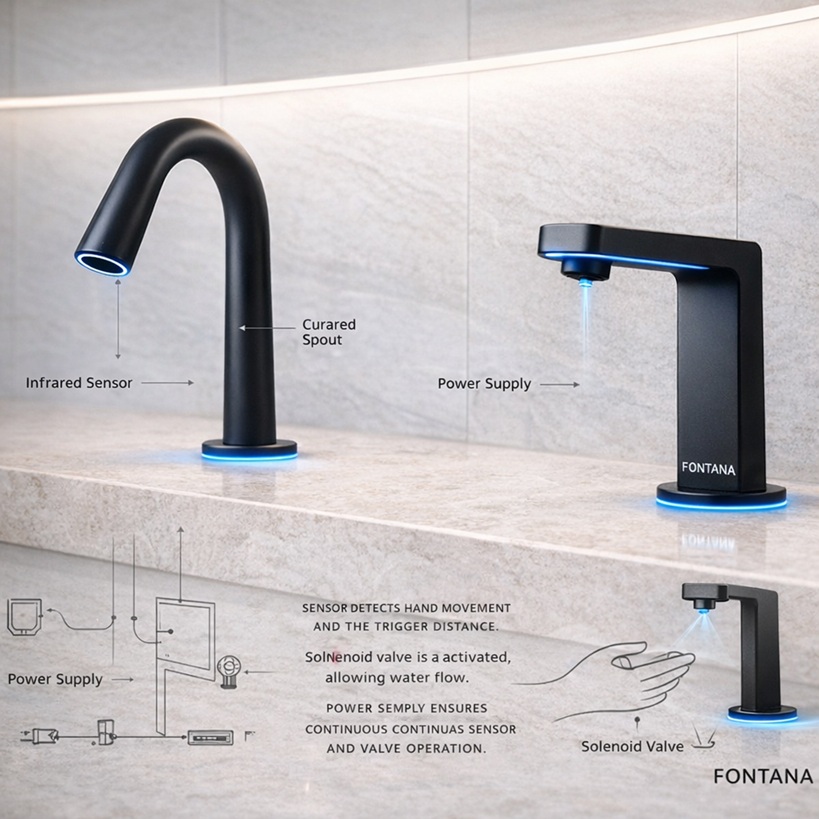
Commercial sensor faucets work by using infrared or Time-of-Flight (ToF) sensors to detect hand presence, which triggers a control module to open a solenoid valve — allowing water to flow automatically without physical contact. The system closes the valve when hands are removed, ensuring touchless, hygienic operation.
Commercial sensor faucets leverage advanced sensing technology to automatically regulate water flow — eliminating the need for physical contact. These intelligent systems have revolutionized plumbing fixtures in modern commercial buildings.
Today, commercial sensor faucets are a standard feature in modern facilities including hospitals, airports, corporate offices, and public restrooms. They improve hygiene, reduce water waste, and enhance user convenience. According to industry studies, sensor faucets can reduce water consumption by 30-70% compared to manual alternatives.
❓ How do these systems actually work from a technical perspective?
In this comprehensive technical guide, we analyze the internal components, sensing technologies, operational logic, and performance factors that power commercial sensor faucets.

What Is a Sensor Faucet?
A sensor faucet — also referred to as a touchless faucet or automatic faucet — is a plumbing fixture that electronically controls water flow using integrated sensors instead of traditional manual handles.
⚡ The sensor detects hand presence and instantly activates water flow — zero physical contact required. This technology is especially critical in healthcare settings where cross-contamination must be minimized.
Why This Technology Matters
Unlike conventional manual faucets, sensor-activated systems deliver measurable advantages that impact both operational efficiency and public health:
- Infection control — Eliminates cross-contamination risks in healthcare and food service environments. Learn more about hygiene standards →
- Water conservation — Reduces water waste by 30–70% compared to manual operation, contributing to LEED certification and sustainability goals.
- Operational consistency — Maintains reliable performance in high-traffic facilities with minimal user intervention required.
- Maintenance intelligence — Enables predictive maintenance and usage analytics through connected systems and smart building integration.
For facility managers and engineers, understanding the internal architecture — from the infrared or ToF sensor to the solenoid valve and control module — is essential for specification, installation, and long-term reliability.

What Affects Sensor Faucet Performance?
Several environmental and technical factors can influence how reliably a commercial sensor faucet operates. Understanding these variables is critical for proper specification and installation in different commercial environments.
💡 Ambient Lighting
Strong direct sunlight or artificial light can interfere with infrared sensors, causing false triggers or detection failure. ToF sensors are significantly less affected by lighting variations, making them ideal for spaces with large windows or variable lighting.
🪞 Reflective Surfaces
Highly polished sinks, chrome fixtures, or surrounding glass materials can reflect IR signals, leading to continuous activation. Matte finishes, proper sensor positioning, or ToF technology effectively solve this common installation challenge.
📏 Installation Height
Sensor range and detection zones are factory-calibrated for specific heights. Incorrect installation reduces accuracy and increases false activations. Always follow manufacturer specifications for optimal performance.
⚙️ Calibration Settings
Many commercial faucets allow sensitivity and range adjustments. Proper calibration matches the sensor to the specific sink depth, basin material, and environmental conditions. Regular recalibration ensures consistent performance over time.
IR vs ToF Sensor Comparison
When comparing infrared (IR) sensors and Time-of-Flight (ToF) sensors in commercial sensor faucets, it is essential to understand how each technology impacts accuracy, reliability, and overall system performance. This comparison helps engineers and facility managers make informed specification decisions.
Infrared sensors operate by emitting light and detecting reflections, making them a cost-effective and widely used solution. However, they can be affected by ambient lighting conditions and reflective surfaces. IR sensors are best suited for standard restroom environments with consistent lighting.
In contrast, ToF sensors measure the time it takes for light to return, providing more precise distance detection. This results in higher accuracy, reduced false activation, and better performance in complex or high-traffic environments. ToF technology is increasingly becoming the standard for premium commercial installations.

| Feature | Infrared (IR) | Time-of-Flight (ToF) |
|---|---|---|
| Accuracy | Moderate | High |
| Cost | Lower ✓ | Higher |
| Reliability | Good | Excellent |
| Environment Sensitivity | Higher | Lower |
| Best Application | Restrooms, general use | Hospitals, labs, high-traffic |
| Detection Range | Short to medium | Long and precise |
| Response Time | Fast | Very fast |
💡 Technical Insight: For healthcare facilities and high-traffic commercial environments, ToF sensors provide superior reliability with up to 95% reduction in false activations compared to standard IR sensors. This translates to fewer maintenance calls and better user satisfaction.
📚 Continue Reading — Technical Series
Frequently Asked Questions (FAQ)
What is the average lifespan of a commercial sensor faucet?
Can sensor faucets work during a power outage?
Why does my sensor faucet keep running continuously?
What is the difference between IR and ToF sensors?
Are sensor faucets more water-efficient than manual ones?
Do commercial sensor faucets meet ADA compliance?
Which brands are most reliable for commercial sensor faucets?
The Future of Commercial Plumbing

Understanding how commercial sensor faucets operate is no longer optional — it’s a strategic advantage. From precise specification and seamless installation to long-term maintenance optimization, deeper technical awareness directly impacts performance and lifecycle cost.
As smart building ecosystems evolve, sensor faucets are rapidly transitioning from simple automation devices to fully connected infrastructure components. With integrated IoT capabilities, facilities can now leverage real-time monitoring, advanced usage analytics, and predictive maintenance — significantly reducing downtime while improving operational efficiency.
Whether you’re designing a next-generation healthcare facility, upgrading high-traffic commercial restrooms, or targeting LEED and sustainability certifications, selecting the right sensing technology — IR or ToF — is a critical decision that directly influences reliability, hygiene standards, and long-term ROI.
📖 Download Technical Specifications →
© 2026 Commercial Sensor Faucet Technical Resource — All specifications and information are based on verified industry standards and manufacturer data.

Miles Arden is a staff writer and editorial team member at commercial-sensor-faucet.com. His editorial work examines touchless restroom technology, maintenance practices, facility operations, and commercial applications, drawing on product documentation, recognized standards, manufacturer materials, and attributable sources.