The sensor lens is usually the first thing to fail, not the valve body or the mounting bracket. An infrared emitter needs a clear optical path to work, which means a window, a gap, or a thin polycarbonate cover that a screwdriver or a bic pen can defeat in seconds. Capacitive sensing reads through solid metal, so there is no window to break, pick, or pack with gum. If you are specifying for a restroom with a known vandalism history, the sensing technology matters more than the gauge of the spout.
Why Infrared Windows Are the Weak Point
Infrared (IR) sensor faucets detect an object by bouncing light off it and reading the reflection, typically at a range of 4 to 6 inches from the spout. That detection window has to be optically clear, which forces the manufacturer to build in a lens or aperture somewhere on the faucet body. In a low-traffic office restroom that lens is a non-issue. In a high-abuse public restroom it is a target. Users pry at it, jam it with paper, or simply crack it with a strike, and once the lens is compromised the faucet either stops triggering or triggers constantly, which drains the battery or burns solenoid cycles for nothing.
IR faucets are not inherently bad units. They are simply the wrong choice where the failure mode is intentional damage rather than wear. The lens is a fixed point of ingress and a fixed point of impact, and no amount of stainless steel around it changes that.
Capacitive Sensing Through Solid Metal
Capacitive (sometimes called field-effect) sensors detect a change in an electrical field caused by a nearby object, and that field can pass through non-conductive or thin-gauge material. In practice this means the sensor electronics sit fully enclosed behind the spout casting, with no external window at all. There is nothing to pry open and nothing to occlude with tape or debris. The tradeoff is that capacitive sensing is more sensitive to installation environment (grounding, nearby metal countertops, plumbing bonding) and typically needs field calibration during setup, so it is not a drop-in swap for IR without checking the install conditions first.
For a spec writer, the practical takeaway is that capacitive units remove an entire category of vandalism, the physical attack on the sensor itself, rather than reinforcing the housing around a vulnerable component.
Solenoid Placement and Impact Exposure
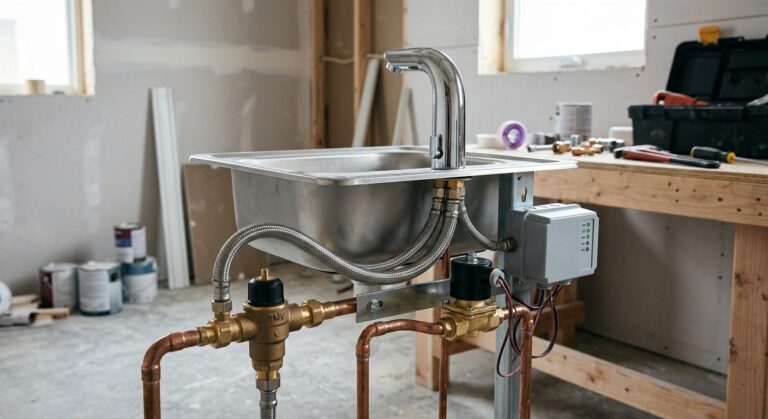
The solenoid is the electromechanical valve that opens and closes water flow when the sensor triggers. Its rated life is usually expressed in cycle count, commonly in the range of one million cycles for commercial-grade units, and that number is a fatigue rating for the plunger and seal, not an impact rating. A solenoid mounted low in the faucet body, close to the deck, sits in the same impact zone as kicks, mop handles, and dropped fixtures. A solenoid mounted higher in the body or offset into a remote control box under the counter is physically removed from that abuse path entirely.
This is where impact resistance actually gets decided. A thick valve body does nothing to protect a solenoid that sits at ankle height if the water supply line itself is what takes the hit and translates the force upward. Where the solenoid lives, not how thick the housing is around it, determines whether a strike takes the faucet offline.
Battery vs Hardwired Under Repeated Strikes
Both power schemes work under abuse, but they fail differently.
- Battery-powered: Self-contained, no wiring run to damage, but the battery compartment is itself a point of entry if it is accessible from outside the fixture. Look for units where the compartment is behind the deck plate or inside the wall, not in an exposed housing at the spout.
- Hardwired (transformer, 6V or 12V DC typical): No battery to steal or tamper with, and no scheduled battery swap for maintenance staff. The vulnerability shifts to the low-voltage wiring run, which needs to be in conduit or behind the wall, not exposed in the cabinet below the sink.
- Hydro-powered (turbine generated off water flow): Eliminates both battery access and external wiring, but ties faucet function to water pressure and flow, so a supply-side problem becomes a power problem too.
For most high-abuse commercial restrooms, hardwired with concealed conduit is the more durable choice specifically because there is no accessible compartment or replaceable part at the fixture itself. Battery units are fine where the restroom sees normal wear and the maintenance team is on a reliable service schedule.
Testing Claims: IK Ratings Explained
IK ratings measure impact resistance under standardized test conditions (IEC 62262), expressed as a number from IK00 (no protection) up to IK10. IK08 corresponds to a 5-joule impact, roughly equivalent to a 1.7 kg mass dropped from 30 cm. IK10 corresponds to a 20-joule impact, roughly a 5 kg mass dropped from 40 cm. That is a fourfold jump in energy absorption between the two ratings, not a marginal upgrade, so treat IK08 and IK10 as different product categories rather than points on the same scale.
A few things to check when a spec sheet lists an IK rating:
- Confirm which component the rating applies to. A faucet can list IK10 for the spout housing while the sensor window or control box carries no rating at all.
- Ask whether the rating was third-party tested or self-certified. Both are common in this category, but you want to know which one you are buying.
- Cross-check the rating against the sensing technology. An IK10 housing wrapped around an exposed IR lens has closed one gap and left the actual failure point untouched.
Specifying for High-Abuse Restrooms
The supply connection is worth checking as its own item. Most commercial faucets use a 1/2 inch NPT threaded supply, and that thread is a mechanical stress point independent of anything happening at the spout. Repeated lateral force on the faucet body, from someone hanging on it or kicking it, transmits down to that threaded joint. A faucet body rated IK10 does not help if the NPT connection at the deck cracks or backs off under the same abuse. Ask the installer to verify torque spec and consider a braided or reinforced supply line rather than rigid copper stub-out in restrooms with a documented abuse history.
When you are pulling together a shortlist, filter first by sensing technology and solenoid placement, then by IK rating on the specific component you care about, and only then by finish and shell design. A supplier catalog of commercial bathroom faucets is a reasonable place to start comparing spec sheets side by side, since most manufacturers publish IK ratings, solenoid cycle counts, and power options in the same document.
Before You Sign the Purchase Order
- Confirm sensing type (IR vs capacitive) and whether the sensor has any external lens or window.
- Get the solenoid’s rated cycle life and its physical location within the faucet body.
- Verify which component the published IK rating actually covers, not just the headline number.
- Decide on battery, hardwired, or hydro power based on maintenance access and abuse history, not just installation cost.
- Check the supply connection spec (typically 1/2 inch NPT) and confirm the installer is using a reinforced line where lateral stress is likely.
If the restroom in question has an active vandalism problem right now, walk the site with the maintenance lead before finalizing the spec. Field conditions, mounting substrate, and existing damage patterns will tell you more than any datasheet about what is actually going to get hit.