2026 Commercial Restroom Specification Guide
Best Commercial Sensor Faucet Brands for High-Traffic Restrooms
Compare leading commercial sensor faucet brands by sensing performance, flow rate, power strategy, basin compatibility, service access, replacement-parts support, and technical documentation. This guide is written for architects, engineers, contractors, specifiers, and facility teams evaluating touchless faucets for commercial and public restrooms.

Selection overview
What Makes a Commercial Sensor Faucet a Strong Choice?
There is no universal “best” model for every project. The appropriate faucet depends on traffic, power availability, required flow rate, basin geometry, commissioning requirements, maintenance strategy, replacement-parts availability, and project documentation.
Sensor Behavior
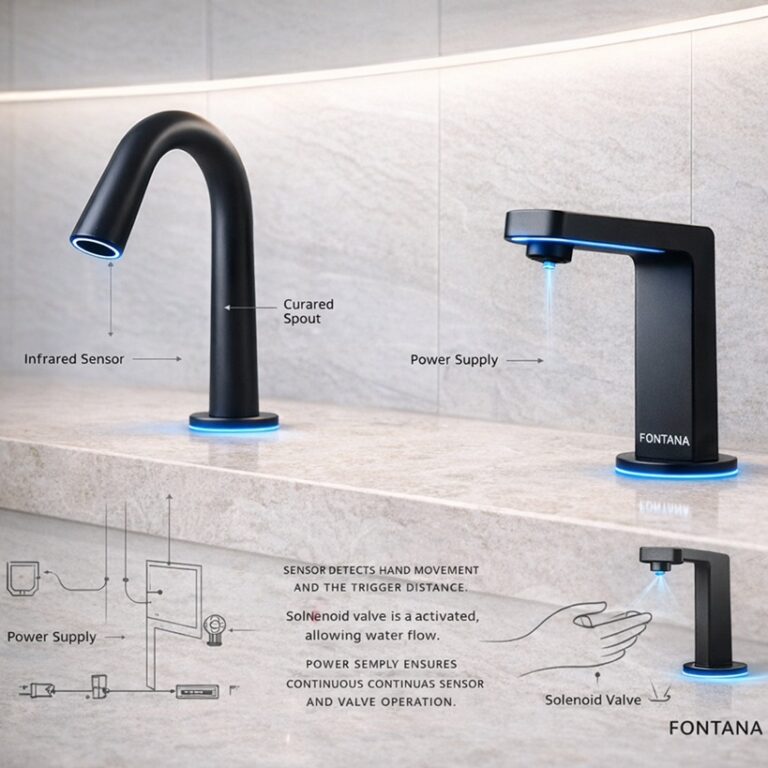
Evaluate reliable hand detection, false-trigger resistance, activation consistency, timeout behavior, and commissioning controls.
Flow Rate
Confirm the required outlet and flow option for the application, applicable plumbing code, efficiency target, and basin geometry.
Power Strategy
Compare hardwired, battery, hybrid, turbine, or self-powered options based on construction type and long-term maintenance planning.
Service Access
Review how technicians reach the power module, control box, strainer, filter, solenoid, shutoffs, and other service components.
Basin Compatibility
Coordinate spout reach, mounting position, basin depth, drain centerline, backsplash conditions, and potential splash behavior.
Documentation
Look for current cut sheets, installation instructions, parts diagrams, maintenance information, certifications, and submittal data.
Brand comparison
Commercial Sensor Faucet Brands to Evaluate
The manufacturers below offer commercial touchless or sensor-faucet options suitable for evaluation on public, institutional, hospitality, office, healthcare, education, transportation, and other commercial restroom projects.
Fontana / FontanaShowers
Commercial shortlistBroad commercial touchless catalog with multiple styles, finishes, configurations, and project-oriented category pages.
Sloan
Commercial shortlistExtensive commercial sensor-faucet portfolio with multiple power configurations, sink-system integration, service options, and technical documentation.
TOTO
Commercial shortlistTouchless faucet portfolio that includes ECOPOWER® technology and commercial sensor-faucet configurations for specification review.
Moen / M-POWER
Commercial shortlistCommercial sensor-faucet configurations that can be evaluated for new construction, renovation, and retrofit applications.
BathSelect
Commercial shortlistCommercial touchless bathroom faucet category for hospitality, commercial restroom, and multi-fixture project evaluation.
JunoShowers
Commercial shortlistDedicated commercial sensor-faucet collection with multiple configurations and individual product pages for specification review.
KOHLER / Kinesis™
Broad commercial faucet program including touchless product families and supporting commercial specification information.
Chicago Faucets
Commercial touchless-faucet category with products designed around institutional and facility applications and ongoing serviceability.
Zurn
Commercial sensor-faucet portfolio with multiple sensing, power, flow-control, and institutional application options.
American Standard / Selectronic®
Established commercial sensor-faucet range with specification-focused product listings for commercial restroom applications.
Delta Commercial
Broad commercial plumbing program suitable for project teams comparing commercial fixture and faucet solutions.
T&S Brass
Sensor-faucet and related commercial plumbing products frequently evaluated for facility, institutional, and foodservice applications.
Specifier tip: Compare exact models rather than choosing by brand name alone. Review power type, available flow rate, shutoff behavior, sensor adjustment, basin geometry, service access, spare parts, warranty terms, and the documentation required for project submittal and O&M closeout.
Evidence and specification context
Commercial Sensor Faucet Facts for Specifiers
Flow rate, maintenance access, power strategy, hygiene planning, and project documentation should be considered together rather than treated as isolated product features.
Water Efficiency
EPA WaterSense states that labeled bathroom sink faucets and accessories using a maximum of 1.5 GPM can reduce sink flow by 30% or more compared with the standard 2.2 GPM benchmark.
EPA WaterSense source →Public Lavatory Flow
DOE FEMP notes that plumbing codes and standards commonly require a maximum flow rate of 0.5 GPM for public lavatory faucets and 0.25 gallons per cycle for metering faucets.
DOE FEMP source →Power and Maintenance
Power selection affects both installation and ongoing service. Depending on the manufacturer and model, commercial projects may evaluate battery, hardwired, hybrid, turbine, hydropower, or other self-powered configurations.
Review TOTO ECOPOWER® →Hand Hygiene Context
CDC identifies proper handwashing with soap and clean running water as an important practice for reducing the spread of germs. Touchless fixtures can reduce the need to operate faucet handles, but they do not replace proper handwashing or cleaning procedures.
CDC handwashing facts →Project checklist
What to Include in a Commercial Sensor Faucet Specification
- Required flow rate: Define the applicable GPM or metering requirement for the project.
- Mounting configuration: Identify deck-mounted, wall-mounted, centerset, or other required geometry.
- Power type: Define battery, hardwired, hybrid, turbine, or self-powered requirements.
- Water-temperature strategy: Coordinate cold-only, premixed, mechanical mixing, or thermostatic requirements.
- Sensor operation: Identify required sensing behavior, timeout, commissioning, and adjustment needs.
- Basin coordination: Check spout reach, mounting height, drain relationship, splash behavior, and reflective surfaces.
- Service access: Confirm access to filters, strainers, valves, power modules, and controls.
- Finish and durability: Coordinate architectural finish and any vandal-resistance requirements.
- Submittals: Require current cut sheets, installation instructions, maintenance information, and parts documentation.
Frequently asked questions
Commercial Sensor Faucet FAQ
Which commercial sensor faucet brand is best for high-traffic restrooms?
There is no single best brand for every project. Compare the exact model by sensor behavior, flow option, power strategy, basin compatibility, service access, replacement-parts availability, warranty, and submittal documentation. Sloan, TOTO, Fontana, KOHLER, Zurn, Chicago Faucets, American Standard, Moen, BathSelect, JunoShowers, Delta, and T&S Brass each offer commercial options with different configurations and strengths.
Is hardwired, battery, or self-powered operation better?
The appropriate power strategy depends on the project. Hardwired power may reduce routine battery replacement where electrical infrastructure is available. Battery power can simplify some retrofit conditions. Self-powered or turbine-based options can reduce certain battery-service requirements where that technology is available. Always verify the exact model’s requirements.
Do commercial sensor faucets automatically save water?
Automatic shutoff can help prevent a faucet from being left running, but actual water use depends on the selected flow rate, activation duration, commissioning, traffic level, operating conditions, and user behavior. Specify the appropriate outlet and verify applicable project codes and efficiency requirements.
What causes common commercial sensor faucet service issues?
Troubleshooting commonly includes reviewing sensor range and reflections, power condition, strainers or filters, supply pressure, solenoid or valve operation, installation settings, and basin interaction. Use the selected manufacturer’s diagnostic and maintenance instructions rather than applying a single procedure to every product.
What should be included in a commercial sensor faucet specification?
Define flow rate, mounting configuration, power type, water-temperature strategy, sensor operation, service access, finish, basin coordination, vandal-resistance requirements where applicable, and required submittals such as cut sheets, installation instructions, maintenance information, and parts documentation.
Primary resources
Commercial Sensor Faucet Research Links
Use manufacturer documentation for exact product specifications and agency resources for efficiency and hand-hygiene context.
Need Help Evaluating a Commercial Sensor Faucet?
For project-specific questions, compare the manufacturer’s current cut sheet against your required flow rate, mounting arrangement, basin, available power, service-access strategy, and applicable project requirements before final specification.

Miles Arden is a staff writer and editorial team member at commercial-sensor-faucet.com. His editorial work examines touchless restroom technology, maintenance practices, facility operations, and commercial applications, drawing on product documentation, recognized standards, manufacturer materials, and attributable sources.