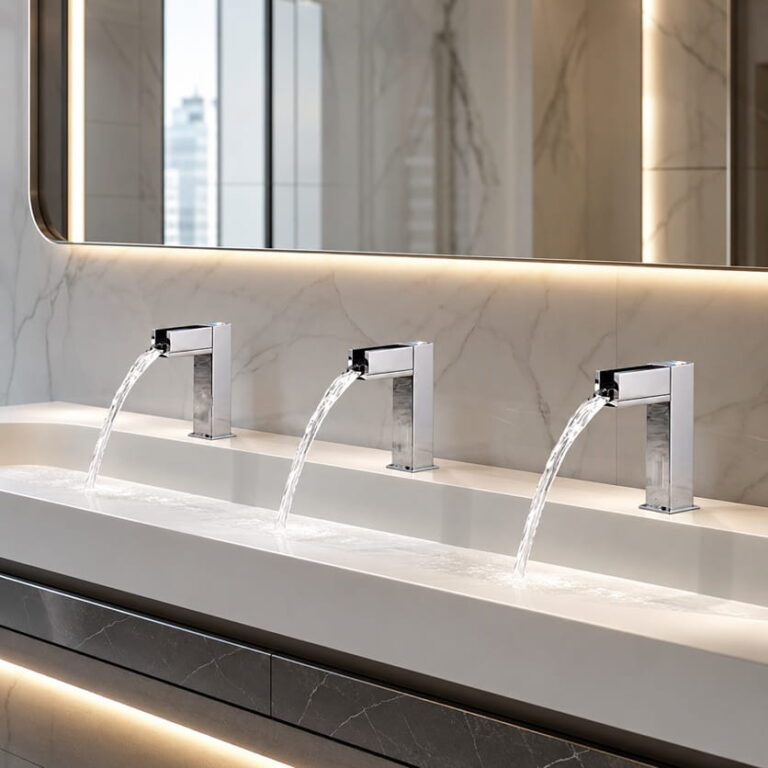
Infrared and capacitive sensor faucets both open the same solenoid valve, but they decide when to open it using different physics. IR sensors measure reflected near-infrared light to estimate distance to an object. Capacitive sensors measure disturbance in an electrical field caused by a grounded mass entering it. That distinction drives everything downstream: false-trigger patterns, detection consistency across hand sizes and skin tones, and how the fixture behaves in a washroom full of stainless steel and south-facing glass.
How Infrared Rangefinding Actually Works
Commercial faucet IR sensors are active rangefinders, not passive heat detectors. An emitter LED pulses near-infrared light, typically in the 850-950nm band, and a photodiode reads the intensity and timing of the reflection. The control board compares the returned signal against a threshold calibrated for a target distance, usually the 4-6 inch window most manufacturers spec as adjustable. When a hand or object enters that zone, enough light reflects back to cross the threshold, and the board fires the solenoid driver.
Because the measurement depends on reflected light intensity, the sensor is actually inferring distance from brightness, not measuring it directly like a time-of-flight laser sensor. That means surface reflectivity matters as much as actual distance. A pale ceramic bowl and a dark granite counter will not return the same signal at the same physical distance, which is why IR faucets ship with a trim potentiometer or DIP-switch range adjustment rather than a fixed factory setting. Techs commissioning a bank of lavatories need to walk each one and tune for the basin finish in front of it, not assume one setting fits the room.
Capacitive Field Sensing Explained
Capacitive sensors work on a different principle entirely. A sensing electrode, usually a plate or ring behind the spout housing, is charged to create a weak electrostatic field. The control circuit continuously monitors the capacitance of that field relative to ground. A hand entering the field acts as a grounded conductive mass and changes the field’s capacitance; the circuit reads that shift against a baseline and triggers the solenoid when the change exceeds a set threshold.
This is mass and conductivity detection, not reflected light detection. The faucet is not “seeing” anything in the optical sense, it is reading a change in an electrical property of the space near the spout. That has a practical consequence: capacitive sensors are largely indifferent to color, finish, and ambient light because none of those variables affect the electrostatic field the way they affect light reflectance. What does affect a capacitive sensor is anything else with mass or conductivity moving into range, including water streams, wet hands resting on the deck, or a metal bottle set near the spout.
False Triggers: Sunlight vs Plumbing Mass
Each technology has a predictable failure mode, and it tracks directly back to its sensing principle.
- IR false triggers: direct or reflected sunlight is the most common cause, because sunlight contains strong near-infrared content that can saturate the photodiode or mimic a reflected pulse. Polished chrome, stainless backsplashes, and glossy stone counters can also bounce the emitter’s own signal back at odd angles, causing phantom activation or inconsistent range.
- Capacitive false triggers: standing water bridging the field, a user leaning a forearm or metal object near the sensing plate, or nearby grounded metal (a steel splash guard, an adjacent faucet body) pulling the baseline capacitance off its calibrated reference.
Neither failure mode is rare once you’ve specified enough units. The practical difference is where the problem shows up. IR issues cluster in sunlit washrooms, skylit atriums, and anywhere the fixture faces a window or glossy wall. Capacitive issues cluster in high-splash environments and installations with a lot of adjacent grounded metal, like multi-station trough sinks with shared steel framing.
Detection Range and Solenoid Cycle Counts
Detection range on most commercial units is spec’d at 4 to 6 inches and adjustable within that band, regardless of sensing method. Range stability matters more than the nominal number, because every inch of drift changes how often the solenoid cycles per use. A sensor set too sensitive re-triggers on hand withdrawal or ambient movement, adding cycles the valve was never going to see under normal use. A sensor set too far re-triggers late or misses brief hand placements, pushing users to wave or hover, which also adds cycles as the system hunts for a stable read.
Solenoid valves are rated for a finite number of open-close cycles before the plunger seal or coil degrades, and that number assumes a reasonably clean trigger signal. Chronic false triggering is one of the more common reasons a solenoid underperforms its rated cycle life in the field, independent of water quality or voltage issues. This is a specification and commissioning problem, not a product defect, and it’s worth checking the actuation log or running a manual trigger test during startup rather than assuming default range settings are correct for the room.
Specifying by Environment and Fixture Type
Match the sensing technology to the room, not to a general preference. The table below summarizes the trade-offs as they actually play out in the field.
| Condition | Better fit | Why |
|---|---|---|
| High natural light, glass facades, skylights | Capacitive | Immune to IR saturation from sunlight |
| Dark or low-reflectivity fixtures and counters | Capacitive or tuned IR | IR threshold calibration is harder on absorbent, dark finishes |
| High-splash, heavy-use troughs and multi-station sinks | IR | Capacitive fields are more easily disturbed by standing water and shared grounded metal |
| Mixed finish renovations (polished chrome, stone, stainless) | Capacitive | Reflectivity variance across finishes doesn’t affect field sensing the same way |
| Standard interior lavatories, no major glare or splash issues | Either | Both perform adequately; choice can follow existing vendor relationship or stock |
For projects weighing both approaches against power source and mounting style, it’s worth reviewing a current set of touchless faucet options side by side, since range adjustability, sensor type, and solenoid specs are usually listed together on the cut sheet and make the comparison faster than cross-referencing separate spec PDFs.
Before finalizing a spec, pull the cut sheet and confirm three things: the sensor type and its adjustable range window, the solenoid’s rated cycle life, and whether the manufacturer publishes a recommended range setting for high-glare or high-splash conditions. If the cut sheet is silent on any of these, call the manufacturer’s technical line before ordering in volume. On renovation jobs with mixed finishes or skylights, do a short on-site test with a sample unit under actual lighting conditions rather than relying on the showroom demo, since showroom lighting rarely matches a south-facing restroom at 2pm.