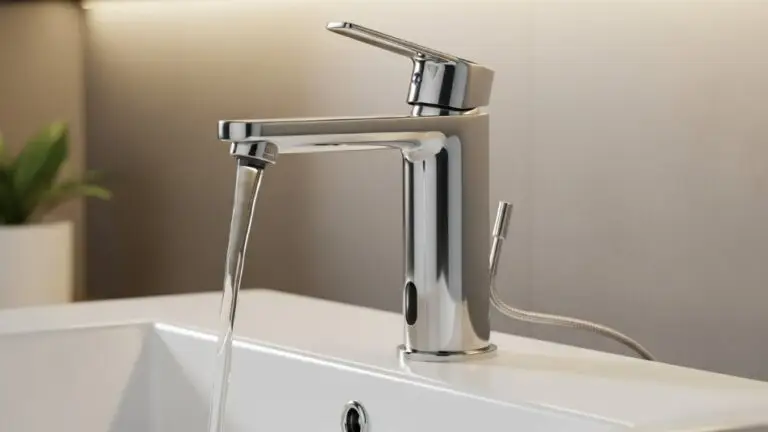
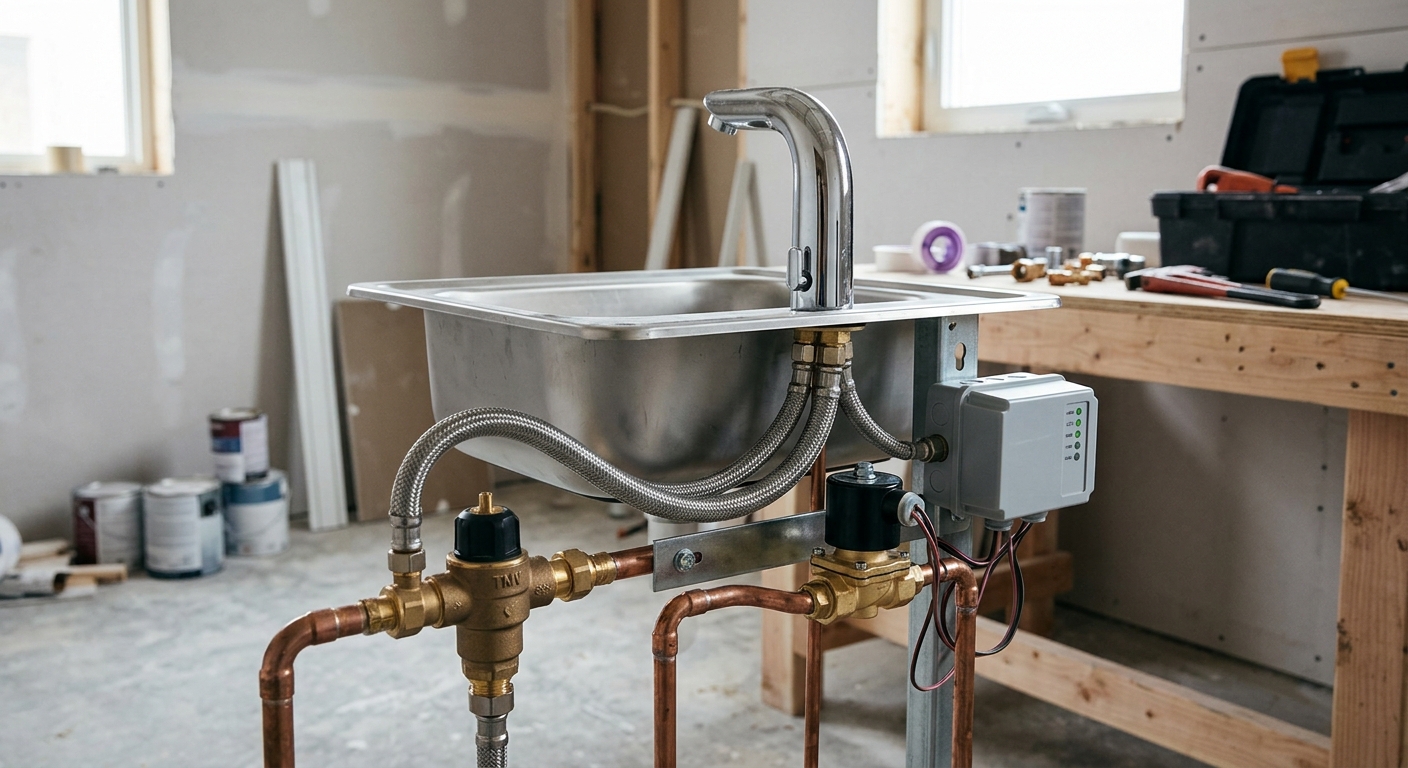
The temperature swing happens because the solenoid and the thermostatic mixing valve are on different clocks. The solenoid opens in milliseconds when the sensor sees a hand. The mixing valve needs a finite amount of time and flow to stabilize blended water at the set point. In the gap between those two events, the faucet delivers whatever was sitting in the line, usually a slug of cold water followed by an overcorrection toward hot before the thermostatic element catches up.
Where the Mixing Valve Sits in the Loop
In a point-of-use configuration, the ASSE 1070 valve sits upstream of the solenoid, blending hot and cold supply before it ever reaches the electronic actuator. That valve is a mechanical thermostatic device, not an electronic one. It reacts to flow and temperature, not to a signal. When the solenoid snaps open, the mixing valve has not yet seen sustained flow, so its internal element is still moving into position. Standard installation guides treat this as a plumbing sequence problem, but functionally it is a timing mismatch between an instant electronic switch and a mechanical valve with inertia.
This matters most in short-duration handwash cycles. A three to five second activation window is barely enough time for a thermostatic cartridge to find equilibrium, especially on a cold start after the faucet has been idle and the line has cooled.
Solenoid Response Time vs Valve Lag
Commercial faucet solenoids typically actuate in under 100 milliseconds from signal to open. Thermostatic mixing valves, by contrast, are rated for response times measured in seconds, often 1 to 3 seconds to reach a stable blended output depending on supply pressure differential and inlet temperature swing. That gap is where the hot-cold-hot cycling comes from.
The mismatch is worse on faucets with fast sensor debounce settings, where the controller triggers the solenoid the instant it sees a hand, with no delay to let upstream water settle. Some commercial controllers allow a short activation delay, 200 to 500 milliseconds, specifically to let the mixing valve get a head start before the solenoid opens fully. If your controller board exposes that setting, use it. If it does not, the workaround is closer valve placement, shortening the distance and the standing water volume between the mixing valve outlet and the solenoid inlet.
IR Range Settings and Water Delivery Timing
Most handwash sensor faucets are set for infrared detection ranges of 4 to 6 inches. That range determines how long the solenoid stays open per activation and how often it cycles during a single handwash. A tighter range triggers shorter, more frequent on-off cycles as hands move in and out of the detection field. Each of those cycles is a fresh timing event for the mixing valve to chase.
Widening the IR range to the upper end of spec reduces the number of discrete activations per handwash, which in turn reduces the number of times the thermostatic valve has to re-stabilize. This is a sensor calibration fix, not a plumbing fix, and it is worth checking before assuming the mixing valve is undersized or defective.
Capacitive Sensors and False-Trigger Risk Near Mixers
Capacitive faucets sense a change in electrical field rather than reflected infrared light, which makes them sensitive to nearby grounded metal mass, including the mixing valve body itself if it is mounted close to the sensor electronics or shares a common deck plate. A poorly isolated capacitive sensor can register a false trigger from someone reaching past the faucet, not just from a hand at the spout. Every false trigger is another unplanned solenoid actuation and another cold-slug event for the mixing valve to correct.
If you are retrofitting motion sensor faucets into a fixture that already has a point-of-use mixing valve installed, confirm which detection technology the faucet uses before assuming a wiring or plumbing fault is the culprit. IR and capacitive units have different failure signatures, and troubleshooting the wrong one wastes a service call.
Power Source Effects on Solenoid Consistency
The power source driving the solenoid affects how consistently it actuates, which in turn affects how predictable the mixing valve’s job is.
- Battery powered (typically 6V AA pack): Actuation force and response time stay consistent for most of the battery life, then degrade as voltage drops near end of life. A weakening battery can cause the solenoid to open incompletely, starving the mixing valve of the flow rate it needs to stabilize.
- Hardwired 24V AC/DC: Delivers consistent actuation voltage regardless of duty cycle, which gives the most predictable solenoid timing of the three options. This is the preferred power source for high-traffic installations paired with thermostatic mixing, precisely because it removes one variable from the timing equation.
- Hydro-powered (turbine generated): Response time depends on line pressure and flow at the moment of activation. Low-pressure conditions can slow the turbine’s charge cycle, delaying solenoid actuation and compounding the lag already present in the mixing valve.
For any installation where hot-cold cycling is already a known complaint, hardwired 24V is the power source least likely to introduce additional variability into the timing problem.
Cycle Life Under Point-of-Use Mixing Loads
Commercial solenoids are typically rated for 100,000 to 200,000 actuations before expected failure. That number assumes a normal duty cycle of full-open, sustained flow, full-close. A faucet fighting a slow-responding mixing valve tends to cycle more often per handwash, as the controller opens and closes the solenoid in short bursts while temperature hunts for the set point, or as users release and re-trigger the sensor because the water feels wrong. Each of those extra cycles counts against the rated actuation life.
In practice this means a faucet with a poorly timed mixing valve upstream may reach its rated cycle count meaningfully faster than the spec sheet duty cycle would suggest, not because the solenoid is defective, but because it is doing more work per handwash than the rating assumes.
| Component | Typical Response/Rating | Relevance to Temperature Swing |
|---|---|---|
| Solenoid actuation | <100 ms open time | Opens before mixing valve has stabilized flow |
| ASSE 1070 mixing valve | 1-3 sec to stable output | Source of the lag the solenoid outruns |
| IR detection range | 4-6 inches (handwash) | Wider range reduces re-trigger frequency |
| Solenoid cycle life | 100,000-200,000 actuations | Extra cycling from hunting shortens service life |
Start by checking the physical distance between the mixing valve outlet and the solenoid inlet. If it is more than a foot or two of pipe, shortening it reduces the standing water volume that has to be purged and re-blended on every activation. Next, check whether the controller board has an adjustable activation delay and, if so, set it to give the mixing valve a head start of a few hundred milliseconds. Confirm the IR range is set toward the wider end of the 4 to 6 inch handwash spec rather than the tightest setting. If the faucet is battery powered and the complaint is intermittent rather than constant, replace the batteries before troubleshooting anything else. If the swing persists after all of that, the mixing valve itself may be undersized for the flow rate the solenoid delivers when fully open, which is a valve sizing question for whoever specified the point-of-use system, not a faucet defect.