
Commercial Sensor Faucets • Public & Enterprise Restrooms
Technical briefing for architects, engineers, and contractors
What this technical reference covers
This page is written as a technical reference for public and enterprise restroom packages. It focuses on engineering constraints (pressure and flow stability, power and controls, service access), architectural coordination (basin geometry, reach, and clearances), and specification deliverables that reduce field rework and lifecycle downtime.
Design basis for public and enterprise deployments
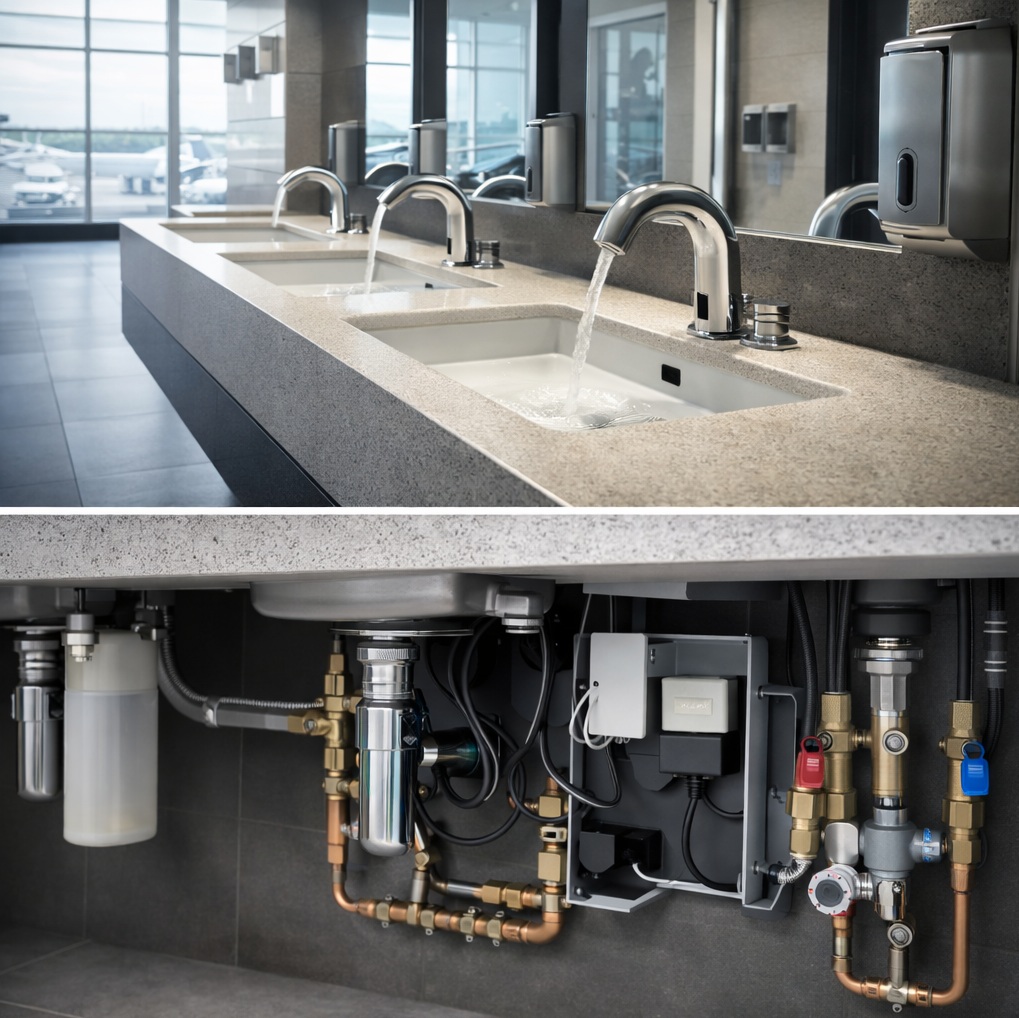
In enterprise buildings, the sink line behaves like a small distributed utility system: hundreds of daily cycles, variable inlet pressure across risers, and frequent cleaning with chemical disinfectants. Sensor faucets add electronics and control logic to a device that is traditionally mechanical. The specification should treat the faucet as a system component, not a decorative trim item.
Performance boundaries that should be defined early
- Operating pressure range at the point of use, including peak and low-demand conditions.
- Outlet type (laminar vs aerated) based on splash control, infection-control requirements, and basin geometry.
- Run-time and shutoff logic to control water waste and reduce nuisance shutoffs.
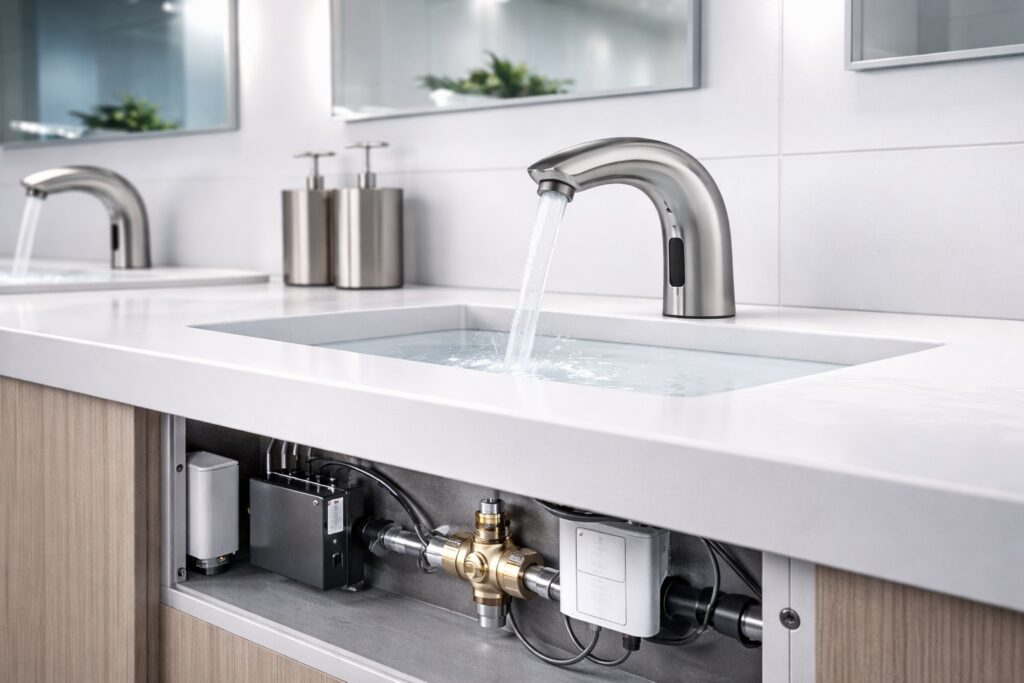
- Mixing strategy (central mixing, point-of-use mixing, or thermostatic control), plus access for adjustment and service.
- Power model (battery, hardwired, or hybrid) aligned with maintenance staffing and electrical rough-in strategy.
Durability and lifecycle reliability
High-traffic restrooms fail in predictable ways: fouled outlets, damaged sensors, leaking cartridges, battery neglect, and inaccessible components. Durability is therefore a combination of materials, sealing strategy, and serviceability.
Material and finish considerations
- Corrosion resistance: verify substrate material and plating system; specify finishes that tolerate facility disinfectants.
- Vandal resistance: reduce exposed fasteners, protect sensor windows, and avoid fragile protrusions on public fixtures.
- Lead-free compliance: confirm lead-content requirements and traceable documentation where applicable.
Cycle life and maintainability
For enterprise deployments, the maintenance plan should assume routine outlet cleaning, periodic battery replacement (if used), sensor calibration checks, and occasional solenoid or cartridge replacement. The spec should require service access that matches those tasks.
Sustainability and water performance
Water performance is not just a flow-rate number. Actual consumption depends on activation reliability, runtime settings, user behavior, and how well the outlet pattern matches the basin geometry.
Flow targets and code alignment
Outlet selection: laminar vs aerated
Laminar outlets are frequently chosen in healthcare and food-related environments due to reduced splashing and a more controlled stream. Aerated outlets can improve perceived wetting at very low flows but may increase splash if basin geometry is not compatible. Specify outlet type in the fixture schedule rather than leaving it implicit.
System integration with commercial bath accessories
Sensor faucets perform best when the sink line is designed as a coordinated system: soap delivery, valves, access panels, and (where used) centralized fill or multi-feed strategies. This reduces mismatched user timing and simplifies O&M training.
Accessory coordination checklist
- Soap dispensing: match actuation style and placement to the faucet so the user flow is obvious and consistent.
- Isolation and mixing valves: document locations, access clearances, and commissioning responsibility.
- Casework and chases: ensure controls and solenoids remain serviceable after millwork and wall finishes are installed.
- Spare parts strategy: standardize on a small set of cartridges, sensors, and power modules when operating multiple facilities.
Controls, telemetry, and enterprise visibility
In large portfolios, facility teams may want consistent control settings across many restrooms and early warning when components drift out of range. When products support it, enterprise features may include runtime profiles, battery health monitoring, and usage anomaly alerts. If these capabilities are part of the design intent, require documentation of data outputs and the integration path during submittals.
Commissioning and closeout deliverables
Sensor faucet commissioning should be treated like other building systems: settings are verified, maintenance access is confirmed, and the final configuration is recorded. This reduces call-backs caused by nuisance shutoffs, excessive runtime, or sensor misalignment.
Commissioning steps that should be documented
- Verify inlet pressure and confirm the installed flow device matches the scheduled flow rate.
- Set sensor range and timeout to align with basin geometry and expected user behavior.
- Confirm mixing temperature stability under realistic demand conditions.
- Record model numbers, installed outlet devices, and setting values for O&M.
Specification checklist (copy-ready)
The table below is a practical way to express sensor faucet requirements in Div 22 schedules and submittal checklists. Adjust values to local jurisdiction and owner standards.
| Item | What to specify | Why it matters |
|---|---|---|
| Outlet type | Laminar or aerated; include flow rate at a reference pressure | Controls splash, user comfort, and compliance across basins and facilities |
| Pressure range | Minimum and maximum operating pressure at the point of use | Prevents nuisance shutdowns and inconsistent stream behavior |
| Power strategy | Battery, hardwire, or hybrid; include access requirements | Directly affects maintenance workload and downtime risk |
| Controls | Sensor range, timeout, auto-shutoff, and any lockout modes | Balances hygiene, water use, and user experience |
| Service access | Clearance for solenoid, filter, mixing valve, and control module | Reduces teardown and speeds corrective maintenance |
| Conformance references | ASME A112.18.1/CSA B125.1, accessibility design standards, water-efficiency requirements | Creates a clear compliance narrative for approvals and submittals |
| Closeout package | Final settings log, maintenance procedures, parts list, and warranty contacts | Improves long-term uptime and consistency across the portfolio |
External references
The links below are included as stable technical references:

Location: Atlanta, GA
Profile: Facility planning expert focused on large-scale commercial installations. Works with developers to implement durable, vandal-resistant soap dispensing solutions in stadiums, transit hubs, and educational campuses.