Power Planning • O&M Strategy • Commissioning

Touchless faucets look simple from the user side. A hand approaches, water turns on, and then shuts off. For AEC teams, the “simple” experience depends heavily on power quality and power strategy.

The same sensor body can behave very differently depending on whether it is running from alkaline AA cells, a plug in transformer, a hardwired low voltage supply, or a hybrid system that blends AC with battery backup.

Power decisions are not just about “will it turn on.” They affect:

  • Sensor stability and repeatability (especially in challenging lighting or reflective sink decks)
  • Valve actuation consistency (opening force, closing speed, and drip control)
  • Uptime during outages and maintenance cycles
  • Commissioning time, punch list risk, and long term service burden
  • Water efficiency goals (flow regulation is one part, but reliable shutoff is the other)

This article breaks down battery, AC, and hybrid approaches in a way that helps architects, engineers, contractors, and facility teams specify systems that behave predictably in real buildings.

What the faucet is actually powering

Most commercial touchless faucet systems include four electrical loads:

  1. Sensor and control board
    This is the “always on” brain. It runs the detection algorithm, timing, safety shutoff, and sometimes self calibration.
  2. Emitter and receiver
    Infrared (IR) or time of flight sensing needs an emitter pulse and a receiver stage. These may draw little power on average, but are sensitive to voltage stability.
  3. Solenoid valve
    The solenoid is the largest short duration load. Many systems draw a current spike when opening, then settle to a lower hold current. Some designs use latching solenoids to reduce hold power.
  4. Indicators and accessories
    LEDs, optional temperature display modules, remote sensors, soap systems, or an external mixing module can add load and increase sensitivity to power sag.

A practical takeaway: battery selection is a load management problem, while AC selection is a power quality and installation coordination problem.

Battery powered systems: best for retrofit and distributed risk

Battery powered touchless faucets are common because they avoid electrical rough in. They are also common in retrofit work where opening walls or adding receptacles is expensive.

Typical battery architectures

  • 4x AA alkaline (6V nominal) is a frequent configuration.
  • Some systems accept lithium cells, or a dedicated battery pack depending on the brand.
  • Higher end designs may incorporate smarter low battery logic and better voltage regulation.

Where batteries shine

  • Retrofits and tenant improvements: no need to coordinate an electrician for a single lavatory.
  • Distributed failure mode: one dead battery affects one fixture, not an entire restroom bank.
  • Fast commissioning: fewer trades involved can shorten close out.

Battery tradeoffs AEC teams should plan around

1) Discharge curve and “brownout” behavior
Battery voltage does not fall linearly. Many alkaline batteries spend a long time near nominal voltage, then decline faster near end of life. If a control board does not regulate voltage well, you may see inconsistent detection or valve chatter before total failure.

2) Current spikes during actuation
Solenoids and LEDs can pull brief peaks. Batteries with higher internal resistance (common near end of life or in cold locations) may sag under load. That sag can cause:

  • delayed opening
  • shorter run times than intended
  • intermittent “dead” behavior that is hard to troubleshoot

3) Maintenance is not optional
Battery powered does not mean maintenance free. It shifts maintenance from the electrical system to the facility team. If you specify battery, you should also specify a maintenance approach.

A battery maintenance plan that works in real buildings

  • Replace batteries on a schedule tied to occupancy and duty cycle, not just “when it dies.”
  • Standardize battery type across a facility to simplify stocking.
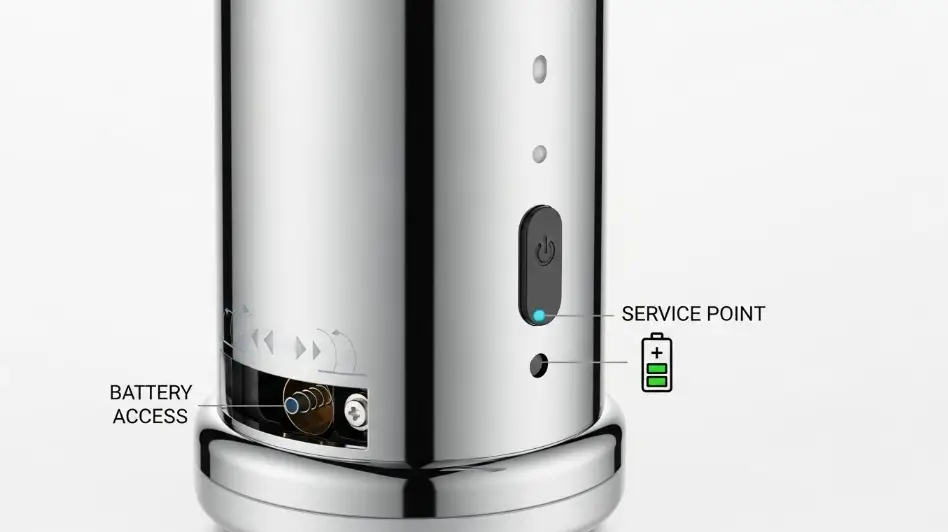
  • Require accessible battery compartments for service without removing the entire spout body.
  • Include a commissioning checklist item: confirm low battery indicator behavior and reset procedure after replacement.

Battery spec checklist (copy into your submittal review)

  • Battery type and quantity (and whether lithium is permitted)
  • Expected cycles or service interval under a stated usage pattern
  • Low battery indication method (LED, flow behavior, lockout)
  • Battery compartment accessibility (front access vs under deck)
  • Whether the system uses a latching solenoid (reduces energy use)
  • Whether the faucet retains settings after battery removal (important for commissioning)

AC powered systems: best for uptime and stable performance

AC powered touchless faucets typically use a transformer that supplies low voltage DC to the faucet controller. You might see plug in transformer to a receptacle under the sink, hardwired transformer or power supply feeding multiple fixtures, or a dedicated low voltage distribution strategy in large restrooms.

Where AC power wins

1) High traffic restrooms where uptime matters
Airports, stadiums, hospitals, schools, and transit hubs benefit from power stability and reduced routine battery labor.

2) Consistent sensing behavior
Stable voltage improves repeatable detection and reduces weird edge cases. This matters in spaces with variable lighting, reflective finishes, or multiple fixtures close together.

3) Predictable O and M
Facility teams often prefer not to manage batteries across dozens or hundreds of points.

AC power considerations that affect design and installation

1) Electrical coordination and access

  • If you specify plug in power, you need a receptacle location and access strategy.
  • Service access matters. A hidden receptacle behind a fixed panel is not helpful when a transformer fails.

2) Power supply safety and listing
Most faucet power supplies are low voltage, but the installation still interacts with code and product listing requirements. It is also common to see “Class 2” style low voltage approaches in building systems. Make sure the supply is appropriately rated and installed per local code and manufacturer instructions.

3) Shared power supply risk
If one transformer feeds multiple faucets, one failure can disable multiple fixtures. This is not automatically bad, but it must be intentional. In critical facilities, you may want redundancy or segmented feeds.

4) Noise and interference
Low voltage runs and poor grounding can introduce electrical noise that affects sensing and control logic. This is more likely in long cable runs or crowded ceiling spaces. Keep wiring organized, avoid running low voltage parallel to high voltage in tight bundles, and follow the manufacturer’s cable length limitations.

AC spec checklist

  • Transformer type (plug in vs hardwired) and output rating
  • Whether power is dedicated per fixture or shared across a group
  • Access requirements for the transformer (serviceable without demolition)
  • Maximum cable length from power supply to fixture
  • Whether the valve is normally closed on power loss (most are) and how it behaves on power return
  • Whether the system requires re calibration after a power interruption

Hybrid power: combining reliability with resilience

Hybrid systems typically mean one of these:

  1. AC primary with battery backup
    The faucet runs on AC power, but automatically switches to battery mode during outages.
  2. Battery primary with optional AC adapter
    The faucet can accept an AC adapter for long term use, but can still run on batteries if AC is removed.
  3. Multi fixture AC with local battery backup
    A shared power supply feeds a bank of fixtures, but each fixture can fail over to battery.

Why hybrid is attractive

  • Keeps sensing stable during normal operation
  • Maintains service during outages (important in healthcare and emergency situations)
  • Reduces routine battery replacement burden because batteries are used mainly during interruptions

Hybrid design details that matter

1) Failover behavior

  • Does the faucet switch instantly or does it reboot?
  • Does it lose calibration settings?
  • Does it signal the mode change to the user or staff?

2) Battery health in standby
Batteries sitting idle for long periods can still degrade. In a hybrid system, batteries can be forgotten until they are suddenly needed. Facilities should still schedule battery replacement even if usage is minimal.

3) Commissioning and troubleshooting clarity
Hybrid systems reduce downtime, but can increase confusion. A faucet that “still works” on batteries may mask an AC failure until a later date. Spec teams should require clear indicators or documentation.

Hybrid spec checklist

  • Backup duration expectation and battery type
  • Mode indication (AC vs battery) if available
  • Behavior on power return (auto resume, recalibrate, retain settings)
  • Settings retention after full power loss
  • Recommended battery replacement interval even in backup role

Side by side comparison table

Decision factor Battery power AC power Hybrid power
Retrofit friendliness Excellent Variable Variable
New construction integration Good Excellent Excellent
Uptime under normal conditions Good if maintained Very high Very high
Uptime during outages Depends Low unless backed up High
Maintenance labor Ongoing battery work Lower routine labor Moderate but predictable
Failure impact Localized Can be localized or grouped Can be localized or grouped
Sensor consistency Can vary near end of battery life Strong Strong
Best fit examples Small offices, quick TIs, limited electrical scope Airports, schools, hospitals, large restrooms Healthcare, mission critical sites, premium restrooms

A practical way to choose: power strategy by project type

Tenant improvement, light commercial, small restroom counts

Battery is often the lowest friction choice if:

  • maintenance staff is reliable
  • battery access is straightforward
  • fixture counts are not huge

Large restroom banks, high traffic public facilities

AC or hybrid is usually better because:

  • routine battery replacement becomes a labor cost and a risk
  • stable performance reduces nuisance calls
  • shared power can be planned cleanly at rough in

Healthcare and critical environments

Hybrid becomes attractive when:

  • you want AC stability for everyday performance
  • you need continued operation during outages
  • you want to avoid the perception of “restroom failures” during emergency power transitions

A simple battery life model for design and O and M planning

Even without manufacturer specific data, you can estimate relative battery stress using a duty cycle approach:

  • Standby draw (always on control board) runs 24/7
  • Event draw happens per activation (sensor detect + solenoid open/close)
  • Event count depends on occupancy and behavioral patterns

Practical ways to make this useful in specs:

  • Ask for a stated battery life under a defined usage rate (example: “X activations per day”)
  • Require that battery replacement can be performed without removing the faucet body
  • Include spare battery provisioning in closeout documents for facility staff

If you do nothing else: define a preventive replacement interval for battery powered or hybrid backup batteries. This alone reduces failures and nuisance calls.

Installation and commissioning notes contractors appreciate

These reduce punch list time and prevent “mystery failures”:

  • Verify water pressure is within the fixture’s operating range before troubleshooting sensor behavior.
  • Confirm the faucet is not being “fooled” by reflective basins, mirror edges, or nearby fixtures.
  • Keep power wiring clean, strain relieved, and protected from moisture.
  • Document transformer locations and circuit or feed identification for AC powered installs.
  • For hybrid systems, test failover at closeout: cut AC, confirm continued operation, restore AC, confirm settings retention.
Docs

Support documents (standards and technical references)

EPA WaterSense Bathroom Faucets overview
Open
WaterSense technical sheet PDF: Bathroom Sink Faucets
Open
2010 ADA Standards for Accessible Design (official)
Open
U.S. Access Board Technical Guide PDF: Operable Parts
Open
ASME A112.18.1/CSA B125.1 (Plumbing Supply Fittings standard listing)
Open
Limited Power Sources and UL1310 Class 2 vs IEC62368-1 discussion
Open
Scroll to Top