
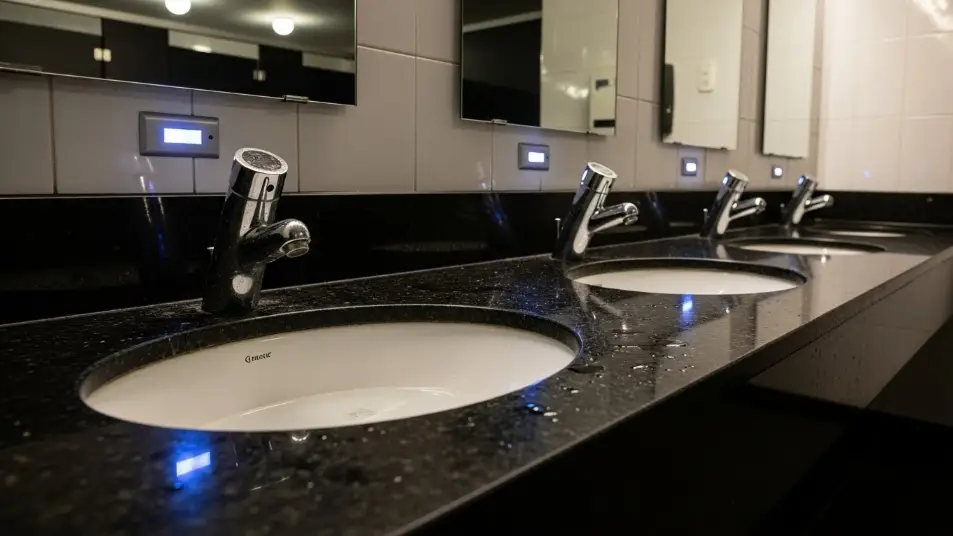
Touchless faucets reduce touch points and help control water use. But in buildings with uneven occupancy, long stretches of low use can increase water age. Automatic purge cycles (automatic line flushing) can support a broader water management plan when sized, commissioned, and maintained correctly.
What an automatic purge cycle is
An automatic purge cycle is a programmed event where the faucet runs water for a defined time or volume without a user present. The intent is usually to reduce stagnant water in small branches, help maintain disinfectant residual and water quality at points of use, exercise valves after idle periods, and in some strategies rinse drains (site dependent).
Why stagnation matters in real buildings
Stagnation can show up in new construction when occupancy is phased, wings are rarely used, tenant fit-outs stall, or low-flow designs reduce turnover in long branches. Stagnant water can contribute to disinfectant residual decay and odor complaints, scale settling that later clogs strainers and outlets, temperature drift in branches and mixing valves, and higher risk of pathogen growth under the right conditions.
Public health guidance generally treats stagnation control as part of a broader water management program, not a single product feature. When risk profiles call for it, align purge cycles with a documented WMP.
Purge cycles are a control measure, not the whole plan
A practical way to treat purge cycles is as a point-of-use control measure that supports a WMP. They tend to make sense in schools with breaks, airports with uneven concourse usage, stadiums between events, offices with vacant floors or hybrid schedules, and healthcare only with infection-control review and validation.
Match purge volume to pipe volume
The most common purge mistake is guessing a duration that “sounds reasonable.” If the branch volume is larger than the purge volume, you may not exchange the stagnant water you are trying to address. Tie purge duration (or target volume) to the volume of water in the branch serving the faucet.
Table 1: Purge sizing inputs to document
| Input | Why it matters | Where to get it |
|---|---|---|
| Branch line diameter and length | Drives water volume and water age | As-builts, field measurements |
| Flow rate at outlet (gpm) | Converts volume into time | Submittals, measured flow at fixture |
| Mixed vs cold-only flushing | Temperature affects risk conditions and energy | Plumbing design and infection-control input |
| Use pattern | Determines whether purge is needed | Facility ops and occupancy schedules |
| Drain capacity and trap condition | Prevents overflow and odor issues | Field verification |
Purge parameters to specify
A purge cycle has three levers: frequency, duration or target volume, and timing window. Coordinate across floors and restroom banks so you do not purge everything at once.
Table 2: Practical purge targets by building condition
| Building condition | Stagnation risk | Purge approach | Key caution |
|---|---|---|---|
| Always-busy public restrooms | Low | Often unnecessary | Avoid wasting water |
| Office floors with partial occupancy | Medium | Off-hours periodic purge for low-use zones | Coordinate timing to avoid noise complaints |
| Seasonal facilities | High | Purge after idle periods and during low-use weeks | Validate drains and water quality objectives |
| Healthcare patient care areas | Higher consequence | Purge only under WMP and infection-control plan | Do not assume purge alone solves pathogen risk |
Commissioning checklist for purge cycles
A. Pre-commissioning checks
- Confirm drains are clear and traps are functional
- Confirm stop valves and filters are accessible
- Verify outlet flow rate on site
- Confirm mixing strategy, especially with thermostatic mixing valves
- Confirm a WMP exists (or is being developed) if purge is justified for hygiene risk control
B. Program settings and document them
- Purge frequency
- Purge duration or target volume
- Time window (after-hours vs occupied hours)
- Per-restroom-bank coordination
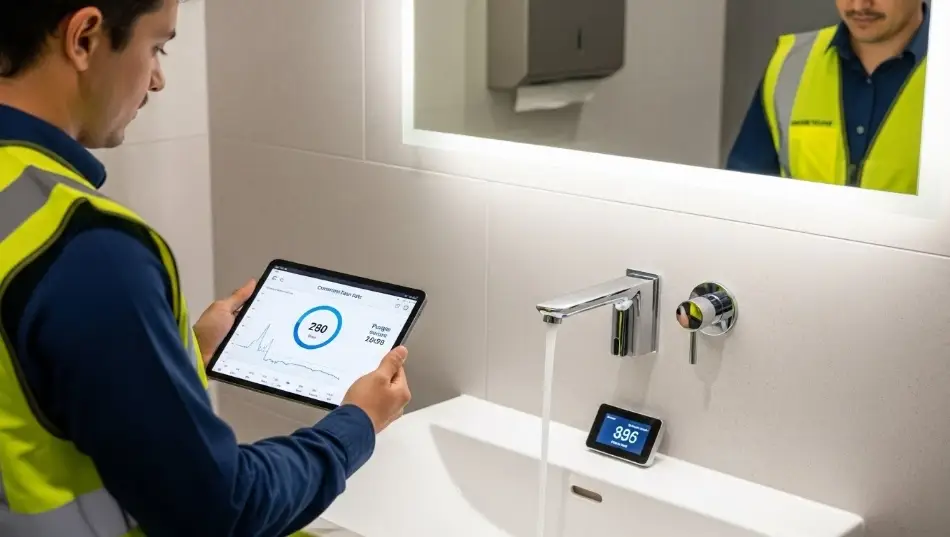
C. Validate flushing actually exchanges water
- Measure outlet flow (gpm)
- Confirm purge time produces enough volume to clear the local branch
- Follow the WMP monitoring approach if water-quality metrics are required
D. Confirm the purge does not create new problems
- No overflow, no persistent oversplash outside the basin
- No nuisance activations that confuse users
- No unacceptable after-hours noise or drain gurgling
- No repeated short cycling that wears valves
Manual flushing vs automatic purge
Table 3: Manual fixture flushing vs automatic purge cycles
| Approach | Strengths | Weaknesses | Best fit |
|---|---|---|---|
| Manual flushing program | Easy to understand, can be targeted to specific wings | Depends on staff compliance, inconsistent documentation | Smaller buildings with stable routines |
| Automatic purge cycles | Consistent, scalable across sites | Can waste water if mis-sized, can overflow if drains fail, needs commissioning | Large portfolios, variable occupancy, campuses, airports |
| Hybrid approach | Manual flush for special events and shutdowns, automatic for baseline turnover | Requires clear ownership and documentation | Complex buildings with seasonal swings |
Do and do not list for AEC teams
Do
- Tie purge settings to a clear purpose: turnover, compliance, post-idle recovery
- Size purge duration to branch volume, not guesswork
- Commission drains and overflow risk
- Document settings in closeout with a simple “what was set and why” record
- Review purge schedules after occupancy changes
Do not
- Run purge cycles without confirming drain function
- Set all faucets in a bank to purge at the exact same minute
- Treat purge cycles as a replacement for a WMP when risk profile calls for one
- Assume more flushing always equals better hygiene
Category pages and key references
Category pages requested
FontanaShowers touchless sensor faucets category
OpenFontanaShowers touchless faucet systems for commercial and institutional restrooms
OpenFontanaCommercial commercial sensor faucets category
OpenJunoShowers commercial bathrooms touchless sensor faucets category
OpenBathSelect commercial touchless bathroom faucets category
OpenWater hygiene and water management references
CDC toolkit: developing a water management program to reduce Legionella growth and spread (PDF)
OpenCDC WMP toolkit landing page
OpenCDC reopening buildings guidance for building water systems after reduced use
OpenCDC control toolkit module: controlling Legionella in potable water systems (PDF)
OpenASHRAE guidance page for water system risk management and Standard 188 context
OpenGSA water quality management FAQ
OpenConnected platform examples referenced
Sloan Connected Products overview
OpenSloan Connect app listing (Google Play)
OpenZurn ZG6951 product page
OpenZurn PlumbSMART overview
Open
Location: Atlanta, GA
Profile: Facility planning expert focused on large-scale commercial installations. Works with developers to implement durable, vandal-resistant soap dispensing solutions in stadiums, transit hubs, and educational campuses.