
In commercial and hospitality projects, faucet selection is as much about code, water safety, and efficiency as it is about form and finish. These certifications are the “invisible framework” behind fixtures that pass inspection, protect occupants, and support sustainability goals.
Introduction
In the realm of commercial and hospitality design, specifying plumbing fixtures is no longer just a matter of form and finish — it’s an exercise in technical compliance. For architects and designers, understanding certification systems such as cUPC, NSF/ANSI 61, NSF/ANSI 372, and WaterSense is essential to ensure that water delivery systems meet regulatory, performance, and sustainability benchmarks.
These standards form the invisible framework behind every well-designed public restroom, ensuring that function, safety, and environmental stewardship converge seamlessly.
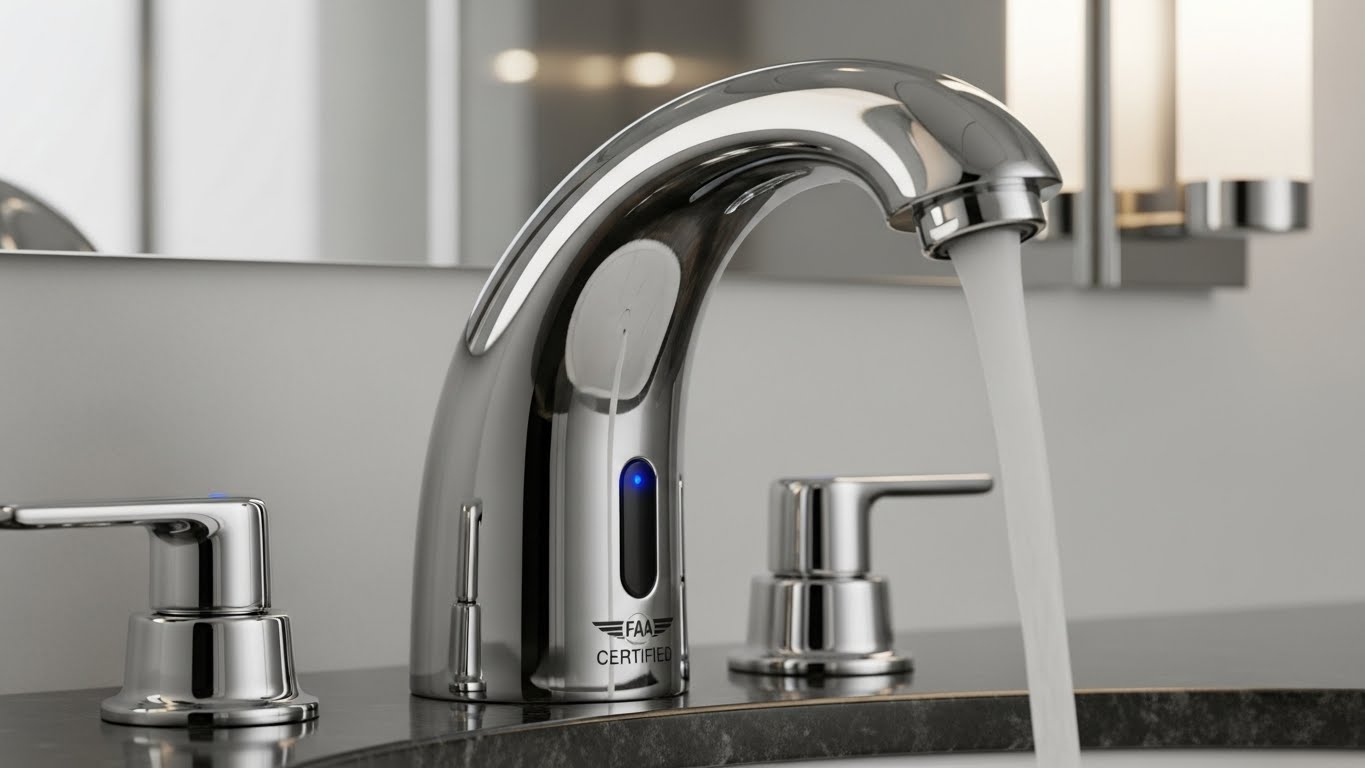
cUPC: The Foundation of Plumbing Code Compliance
IAPMO gives out the cUPC certification for the Uniform Plumbing Code. This shows that a product meets the plumbing standards for North America. This certification gives building officials and engineers confidence that a product has been tested for hydraulic performance, backflow prevention, and mechanical integrity to make sure it meets or exceeds code requirements for commercial and hospitality projects.
For architects, specifying a cUPC-certified faucet reduces compatibility concerns across jurisdictions — especially important in mixed-use or multi-state projects where varying local enforcement can complicate fixture selection.
NSF/ANSI 61 and 372: Material Integrity and Water Safety
Beyond flow performance, NSF/ANSI 61 and 372 address the more critical concern of water quality.
- NSF/ANSI 61 sets limits on contaminants that can leach from plumbing components into drinking water.
- NSF/ANSI 372 defines acceptable thresholds for lead content in fixtures and fittings.
For architects designing public facilities — particularly schools, hospitals, or airports — these certifications function as mandated safeguards. Specifying fixtures that carry both helps protect potable water quality from source to spout and aligns with strict low-lead requirements.

WaterSense: Designing for Conservation and Efficiency
To make the program more comprehensive, the EPA WaterSense logo brings in the sustainability concept. Water-efficient faucets with the WaterSense logo conserve water by reducing the flow rate without hampering comfort, which uses, on average, 30% less water compared to other faucets.
Technically, WaterSense helps meet the objectives of the water efficiency category and can help enhance the sustainability story of the project, especially in high-use hospitality and institutional spaces, where relativel y minor flow reductions add up.
Integration in Specification Practice
When cUPC, NSF/ANSI 61, NSF/ANSI 372, and WaterSense appear together on a submittal, they collectively signify a fixture aligned with health-protective codes and performance-based standards.
This makes it easier to coordinate: mechanical engineers get more confident in performance, contractors have less risk of inspections, and owners get long-term reliability and compliance. Design driven by certification connects looks with responsibility by making sure that the visible fixture is based on engineering accuracy and trust from regulators.
Final Thoughts
Architectural specification is becoming more and more of a technical field. As water systems are used more and more in building designs that are good for the environment and people’s health, it is just as important to understand certification frameworks as it is to understand materials or geometry.
They not only make sure that their plans meet the standards set by cUPC, NSF, or WaterSense, but they also improve the technical skill of what they do by creating spaces where safety, sustainability, and performance come together.
Quick Summary: What Each Certification Covers
| Certification | What it covers | Why it matters in commercial specs |
|---|---|---|
| cUPC | Plumbing code compliance, performance, backflow + mechanical integrity | Improves approval confidence across jurisdictions and reduces inspection risk |
| NSF/ANSI 61 | Limits the number of pollutants that can get into drinking water | Helps keep drinking water safe in buildings that are open to the public |
| NSF/ANSI 372 | Low-lead content thresholds for fixtures and fittings | Meets low-lead expectations for schools, healthcare, and strict jurisdictions |
| WaterSense | Water-efficiency performance without major user impact | Cuts operating costs and supports sustainability targets in high-traffic spaces |
Verified Links
-
epa.gov
WaterSense program overview (add link)Add the official WaterSense reference you want readers to verify. -
iapmo.org
cUPC / UPC certification reference (add link)Add your preferred IAPMO/cUPC reference page here. -
nsf.org
NSF/ANSI 61 & 372 references (add links)Add NSF references or listings you want to cite for the standards.

Location: New York, NY
Profile: Public health–oriented restroom design strategist. Specializes in hygiene-forward environments using contactless soap dispensers, antimicrobial materials, and code-compliant sink configurations for schools and healthcare facilities.